
Choosing between Acumatica and NetSuite is a platform-fit decision determined by investment model, reporting requirements, and implementation timeline, not brand recognition.
Acumatica fits PE-backed businesses that prioritize operational speed, unlimited-user access, and deployment flexibility. NetSuite fits businesses that operate across multiple entities, require mature financial controls, and run finance-heavy reporting structures.
For private equity firms, the core question is which platform helps a portfolio company standardize reporting faster, scale operations without implementation drag, and support measurable value creation within the investment period.
This comparison covers both platforms across 10 decision variables pricing, core features, industry fit, scalability, customization, implementation, and user experience — with no vendor bias.
Why This Decision Matters More in Private Equity ?
A private equity-backed company does not evaluate ERP the same way a typical middle-market business does. The stakes are different.
After acquisition, the pressure starts immediately. Operating partners need visibility. CFOs need cleaner reporting. Leadership teams need systems that can support integration, scale, and audit readiness without slowing down the value creation plan. If the ERP platform is too rigid, too slow to implement, or too expensive to expand across the business, it becomes a drag on execution.
That is why ERP selection in private equity should be evaluated against:
-
implementation speed
-
multi-entity management
-
ease of adoption across growing teams
-
reporting flexibility
-
integration requirements
-
post-acquisition scalability
-
exit-readiness
Which One Should You Choose?
Acumatica and NetSuite serve two distinct business profiles, and the correct choice maps directly to company size, operational structure, and cost model.
Acumatica suits mid-market businesses with large user teams, manufacturing or distribution operations, and a preference for consumption-based pricing — where cost stays fixed regardless of how many users access the system.
NetSuite suits businesses managing multiple legal entities, international subsidiaries, or complex revenue recognition requirements — where enterprise-grade financial controls and consolidated multi-currency reporting are non-negotiable.
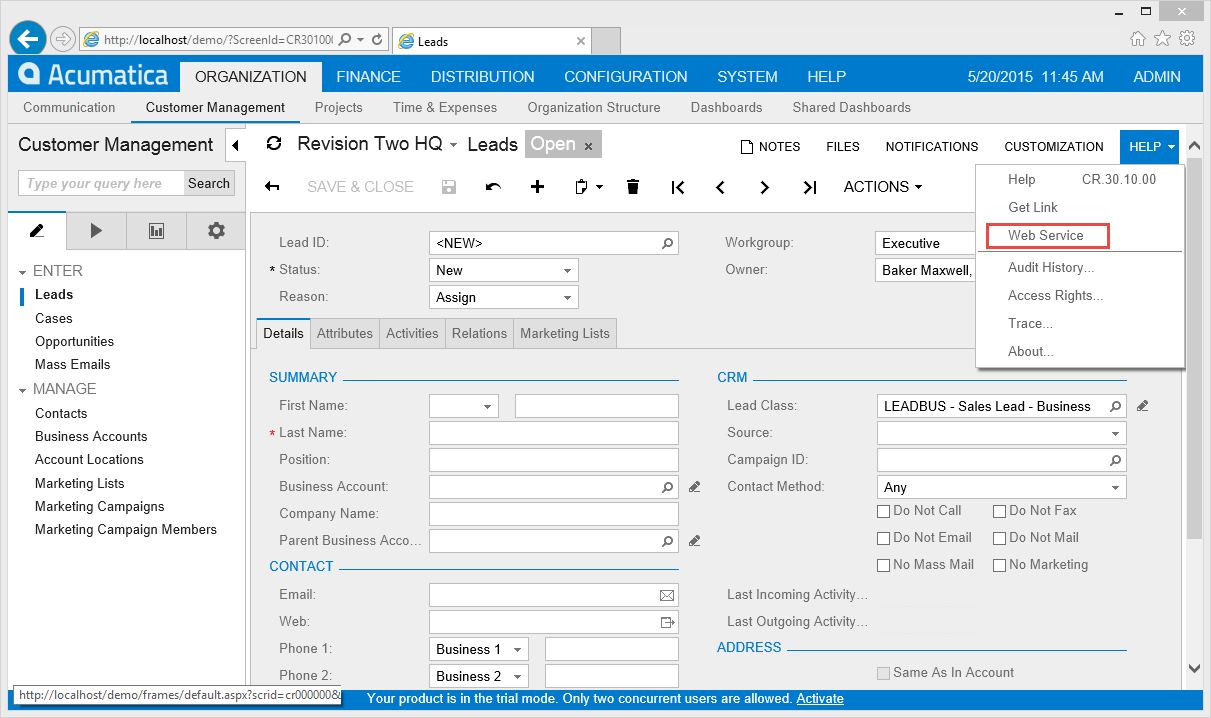
What Is Acumatica?
Acumatica is a cloud ERP platform founded in 2008 and headquartered in Bellevue, Washington, built for mid-market businesses across manufacturing, distribution, construction, and field services.
Koch Equity Development, a subsidiary of Koch Industries, acquired Acumatica in 2019 and funds its ongoing product development.
The platform runs on a consumption-based pricing model businesses pay by transaction volume and resource usage, not by user count. This structure makes Acumatica cost-stable for operations with 50 or more concurrent users.
Acumatica supports 3 deployment options: public cloud, private cloud, and on-premise, giving IT teams direct control over infrastructure decisions. The platform covers 6 core functional areas: financial management, inventory control, order management, project accounting, CRM, and field service operations.
Mid-market businesses with 50 to 1,000 employees represent Acumatica's primary user base, with the strongest adoption concentrated in manufacturing and distribution sectors.
What Is NetSuite?
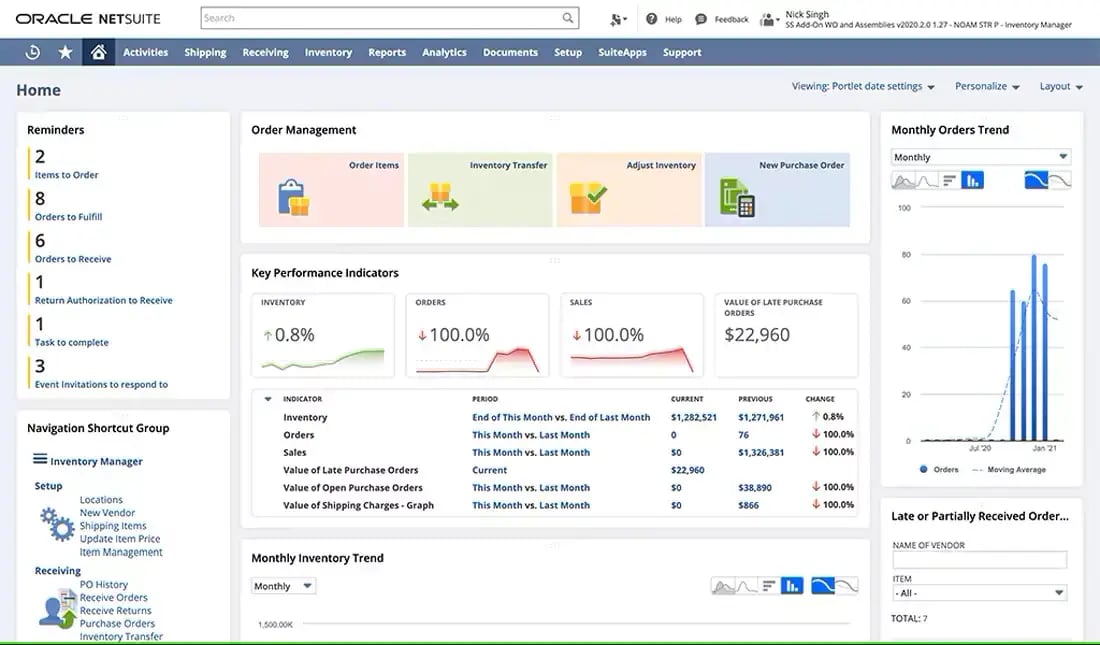
NetSuite is a cloud-based ERP platform founded in 1998 by Evan Goldberg, making it one of the earliest SaaS ERP systems built entirely for cloud delivery.
Oracle Corporation acquired NetSuite in 2016 for $9.3 billion, integrating it into Oracle's cloud application portfolio while maintaining NetSuite as a standalone product line.
Over 40,000 businesses across 219 countries and territories run NetSuite as their primary ERP system, with the strongest concentration in SaaS companies, professional services firms, wholesale distributors, and multi-entity enterprises.
The platform operates on Oracle's Suite Cloud development framework, which supports custom workflow automation, third-party integrations, and module-level configuration without direct code modification.
NetSuite covers 8 core functional areas: financial management, multi-entity consolidation, revenue recognition, inventory management, order management, CRM, project accounting, and human capital management. Its multi-entity and intercompany accounting engine handles up to hundreds of subsidiaries within a single platform instance a capability that positions it as the dominant ERP choice for finance-heavy and PE-backed business structures.
Where Acumatica Has the Edge in Private Equity
Faster implementation for compressed hold periods
Private equity firms do not have the luxury of waiting 12 to 18 months for systems to catch up. A delayed ERP rollout compresses the value creation window and creates downstream risk at exit.
Acumatica is often the stronger fit when the business needs to move quickly after acquisition. On your site, your positioning already reflects this advantage clearly: PE-backed implementations scoped around rapid deployment, portfolio visibility, and post-acquisition integration. That is exactly where Acumatica tends to perform well for private equity teams.
Unlimited-user access supports broader adoption
One of the biggest operational benefits in a PE environment is being able to give access to more people without turning ERP licensing into a budget fight. Portfolio growth usually means more stakeholders, more operators, more controllers, more finance users, and more reporting needs.
Acumatica’s consumption-based model is a meaningful advantage here. It makes it easier to expand access across departments and newly acquired entities without the same level of per-seat friction.
Better fit for buy-and-build strategies
Private equity-backed companies often need a system that can absorb complexity over time. Add-on acquisitions, new entities, new reporting requirements, and evolving operational processes all create pressure on the ERP environment.
Acumatica is attractive when the portfolio company needs flexibility, low-code adaptability, cloud access, and a platform that can evolve alongside the operating model. That makes it a strong fit for companies actively integrating acquisitions or standardizing systems during the hold period.
Strong operational and multi-entity visibility
For PE-backed companies, ERP is not just an accounting system. It is a value creation system. Acumatica’s strength is that it supports multi-entity reporting, intercompany visibility, and real-time access to operating data in a way that aligns well with portfolio oversight and post-close execution.
Where NetSuite May Be the Better Fit
More established finance-centric environments
NetSuite can be a strong choice when the portfolio company already has a mature finance team, more complex entity structures, and a business model that requires a deeply finance-oriented ERP environment from the start.
If the company already operates with stronger finance discipline, broader internal ERP ownership, and a need for mature enterprise controls, NetSuite may fit the organization well.
Larger mid-market complexity
Some PE-backed companies are not in a fast-moving system cleanup phase. They are already operating at a scale where the priority is less about implementation speed and more about managing a more developed finance and enterprise environment. In those scenarios, NetSuite may be the better fit.
Organizations prepared for a more structured ERP model
NetSuite can work well when the business is ready to invest in a more structured ERP environment and has the internal capacity to support it. If the organization is disciplined, process-heavy, and willing to absorb a more formal ERP operating model, NetSuite deserves serious consideration.
When Acumatica Is Usually the Better Choice
Acumatica is often the better fit when:
-
The portfolio company needs to go live quickly after acquisition
-
The business is expanding through acquisitions or roll-ups
-
More users across finance, operations, and leadership need access
-
Licensing flexibility matters
-
The ERP must support both operational execution and financial reporting
-
The company is moving off QuickBooks or fragmented legacy tools
-
The PE firm needs faster reporting, stronger controls, and cleaner visibility without overengineering the environment
When NetSuite Is Usually the Better Choice
NetSuite is often the better fit when:
-
Finance complexity outweighs the need for rapid operational deployment
-
The implementation timeline is less constrained by immediate post-close priorities
-
The internal team is already prepared to manage a broader enterprise software model
Core Features Compared
-
Financial Management: General ledger, accounts payable, accounts receivable, cash management, and tax reporting.
-
Supply Chain & Inventory: Warehouse management, order management, and automated procurement.
-
Customer Management (CRM): Built-in tools for tracking sales leads, managing marketing campaigns, and providing customer support.
-
Project Accounting: Time tracking, expense management, and budget tracking for project-based businesses.
-
Reporting & AI: Role-based dashboards, personalized KPIs, and artificial intelligence for data entry and workflow automation.
Industry-Specific Editions
Acumatica goes beyond basic accounting software by offering tailored editions to meet the complex needs of specific sectors: [1, 2]
-
Construction: Manages project bidding, subcontractor compliance, and job costing.
-
Manufacturing: Features bill of materials (BOM), routing, production scheduling, and material planning.
-
Distribution: Handles complex inventory control, purchasing, and sales order allocations.
-
Retail-Commerce: Unifies point-of-sale (POS) systems with major ecommerce platforms (like Shopify and BigCommerce).
-
Professional Services: Focuses on resource management and accurate project billing. [1, 2]
Why Acumatica Is the Better Choice
Acumatica leads NetSuite across five documented dimensions: implementation transparency, predictable costs, customer-friendly practices, usability, and partner ecosystem quality.
Transparent Implementations
Acumatica delivers detailed implementation plans built around a thorough Discovery phase with configured process flows. A FastTrack deployment option accelerates go-live with no hidden scope limitations. Clients deploy unique business processes directly into the platform, preserving competitive differentiation post-go-live.
NetSuite's SuiteSuccess installations offer low upfront costs but operate on a pre-set, limited scope — processes outside that scope generate additional charges after contract signing.
Predictable Costs
Acumatica provides lifetime price increase protection, charging by transaction volume and resource consumption not by user count. Unlimited users access the platform at no additional per-seat cost, including consultants, auditors, subcontractors, trading partners, and seasonal users. Per Metcalfe's Law, each additional user reduces effective per-user cost as network value grows.
NetSuite's initial discounts of 30–50% revert to then-current list prices after the contract term whether 1, 3, or 5 years with post-renewal increases of 50% or more documented across multiple accounts.
Customer-Friendly Business Practices
Acumatica's published Customer Bill of Rights formalizes fair pricing, implementation transparency, and respectful partnership terms as contractual commitments. The platform holds multiple NPS and client satisfaction awards and offers flexible deployment and licensing options across cloud, on-premise, and hybrid models.
NetSuite has documented claims of deceptive sales practices, including over-promising, underestimating price quotes, and lack of transparency across the sales cycle.
Usability and Customer Satisfaction
Acumatica holds multiple analyst usability awards from G2, Capterra, and Gartner Peer Insights. Workflows, business events, dashboards, forms, and table configurations customize through a user-accessible interface without developer involvement. Color-coded next-step keys guide users through logical process sequences, reducing task completion time and training cost.
NetSuite users on G2 and Capterra consistently report interface complexity, non-intuitive navigation, and performance lag as primary friction points across non-finance departments.
Superior Partner Ecosystem
Acumatica operates through a channel-only model with 350 active VARs and 270 ISVs as of 2024 — no direct sales channel competes against its partners. Every VAR meets structured certification and skills badge requirements, and clients receive dual-layer support covering platform and implementation needs post-go-live.
NetSuite terminated approximately 150 VAR relationships and laid off around 4,000 staff in April 2023 while expanding direct sales, creating active channel conflict. Technology Management Concepts and The Answer Company are two documented cases of former NetSuite partners that stopped selling the platform. Multiple remaining partners now recommend alternate ERP systems, citing deteriorating margin protection and reduced support from Oracle NetSuite.
FAQ
Is Acumatica better than NetSuite for private equity?
For many PE-backed companies, yes. Acumatica is often better when implementation speed, licensing flexibility, and operational scalability matter most.
Why do private equity firms choose Acumatica?
Private equity teams often choose Acumatica because it supports faster deployment, multi-entity reporting, unlimited-user access, and strong post-acquisition adaptability.
Is NetSuite still a strong ERP for portfolio companies?
Yes. NetSuite can be a strong choice for portfolio companies with higher finance complexity and the internal maturity to support a more structured ERP environment.
What matters most when comparing Acumatica and NetSuite in private equity?
The most important factors are implementation timeline, multi-entity reporting, user access, integration needs, post-acquisition scalability, and exit-readiness.
Final Thoughts
Acumatica and NetSuite serve fundamentally different business profiles and in private equity, that distinction carries direct financial and operational consequences.
Acumatica fits PE-backed companies that need fast deployment, unlimited-user access, and a flexible platform that absorbs operational complexity during the hold period. NetSuite fits businesses with mature finance structures, complex multi-entity consolidation, and internal capacity to support a more structured ERP environment.
For most mid-market portfolio companies, Acumatica delivers faster time-to-value, lower total cost of ownership, and stronger operational fit across manufacturing, distribution, and construction verticals without per-seat cost escalation or hidden scope additions at renewal.
The right ERP decision in private equity maps directly to implementation speed, reporting visibility, and exit-readiness. For most PE-backed mid-market businesses, Acumatica delivers that outcome faster, at lower cost, and with less implementation risk than NetSuite.
Still Not Sure Which ERP Fits Your Portfolio?
ERP for Private Equity specializes in rapid ERP implementation and financial system optimization for PE firms and their portfolio companies. Our team evaluates your investment model, operational structure, and reporting requirements — and recommends the platform that accelerates value creation within your hold period.