










Skip to content

Trusted by Private Equity Firms

atlantix
blue-point-capital
hill-co-vision
icare
kidspot
ms
olympus
ppss
suncoast-v2
twang
Spot-on-Greyscale-transparent

Why Standard ERP Implementations Fail Private Equity 

At erp for private equity Most ERP implementations are built for stable, single-entity businesses with predictable timelines. Private equity operates under entirely different pressures and generic consultants fail to account for that reality. 

Tight Hold Period Timelines Leave No Room for Delayed Go-Lives
Time directly impacts returns in private equity. A 6-month implementation delay inside a 5-year hold period compresses your value creation window and risks exit timelines. Generic consultants work on open-ended schedules that ignore PE's commercial urgency. 
Disconnected Systems Kill Portfolio Reporting Visibility
When each portfolio company runs on a different system, financial consolidation becomes manual and error-prone. Operating partners manage spreadsheets instead of performance with no real-time visibility into investment metrics. 
Generic Consultants Don't Understand PE Value Creation
Standard consultants implement software they don't understand IRR targets, EBITDA improvement plans, or value creation roadmaps. When your ERP isn't aligned to your investment thesis, it becomes a cost center instead of a value driver. 
Poor Data Integrity Ruins Exit Valuations
Clean, audit-ready financial data is critical to exit success. Poor data migration, inconsistent chart of accounts, and unreconciled financials slow due diligence, erode buyer confidence, and directly impact valuation. 
Add-On Acquisitions Create Incompatible Tech Stacks
Every bolt-on acquisition brings its own systems and data structures. Without deliberate post-acquisition integration, portfolio companies accumulate incompatible technology that makes consolidated reporting impossible and complicates exit. 
All industries

iCare Health Solutions

Vendor Controls for Audit Compliance

Healthcare distribution & eye care organization in South Florida; >1,000 employees.

  • Industry: Healthcare Distribution
  • Location: Miami, Florida
  • Products: Advanced Distribution, Vendor Approval Customization

“As the business was growing, implementing Acumatica was the company's best decision because we could consolidate most processes and reduce the time to execute them. With correct controls implemented, we could split responsibilities and track all steps until invoices were paid.”

Juan Enriquez, Controller

Key Challenges

  • 5,000+ monthly disbursements with varied methods & multiple cash accounts
  • No standardized AP controls; limited vendor-record approval
  • Auditing complexity and higher compliance risk

Key Results

  • Streamlined cash accounts; reduced payment methods
  • Custom package requiring vendor approval before use
  • NACHA-based electronic disbursements—less manual work
  • Improved internal audit function & reduced risk

Atlantix Partners

Inter-company Accounting Automated

Financial consulting firm based in South Florida focused on serving a variety of market segments.

Overview

After the majority owner sold the company to a private equity group, Atlantix recognized that a growth-through-acquisition strategy would be critical to their future success. However, their use of QuickBooks made it difficult to efficiently integrate and scale acquired entities. By transitioning to the Acumatica cloud ERP platform, Atlantix leveraged intercompany automation and other functionalities to support their aggressive acquisition plan.

  • Industry: Professional Services
  • Location: Fort Lauderdale, Florida
  • Number of Employees: >200
  • Products: Acumatica Advanced Edition

Customer quote goes here to highlight value and impact. Replace with an approved testimonial.

Client Name, Title

Key Challenges

  • QuickBooks lacked capabilities to effectively manage and integrate acquired companies
  • Manual, time‑consuming onboarding of new acquisitions hindered rapid M&A scaling
  • Need for a robust, enterprise‑level ERP for automation, reporting, and functionality to support an evolving business model

Key Results

  • Acquired 6 new entities over 12 months and integrated them into Acumatica with minimal effort and no additional licensing costs
  • Leveraged unlimited user licensing and intercompany branch functionality to rapidly onboard acquisitions and achieve operational efficiencies
  • Freed teams to focus on integrating acquired companies and driving growth instead of complex IT integrations

PPSS: An ERP Experience Tailored to M&A’s

Overview

Premier Physician Support Services (Premier) is a management services organization (MSO) in South Florida supporting wholly owned and affiliated doctor networks, delivering care directly to patients.

After a private equity group acquired a majority stake, the team needed an enterprise resource planning (ERP) platform to support growth. A fast, two-month Acumatica rollout enabled Premier to begin an acquisition-driven strategy, expanding to nine-plus wholly owned subsidiaries and more than 90 affiliates.

  • Company: Premier Physicians Support Services
  • Website: premierphysicianss.com
  • Industry: Healthcare
  • Location: Miami, Florida
  • Employees: >100
  • Products: Acumatica Advanced Edition

“Insert customer quote here to highlight business impact and results.”

Client Name, Title

Key Challenges

  • Transitioning to a new ownership structure with a private equity group
  • Needing a robust ERP to support planned growth
  • Standing up Acumatica quickly to enable the growth strategy

Key Results

  • Acumatica implemented in two months, establishing a scalable platform for expansion
  • Unlimited licensing model supported rapid expansion to 9+ subsidiaries and 90+ affiliates
  • Added CRM, contract, and case management with Outlook, Office 365, and Exchange integrations
  • Stronger sales platform and expanded affiliate networks across Florida

Chemistry Rx: Unique Specifications for Pharmaceutical Sales Orders

Overview

Chemistry RX is a Pennsylvania-based pharmaceutical compound organization specializing in unique, specialized prescriptions.

After being acquired by a private equity group, the company embarked on an aggressive growth strategy, adding new entities. QuickBooks couldn’t keep pace—especially for intercompany operations and automation—so the team moved to Acumatica.

  • Company: Chemistry Rx
  • Website: chemistryrx.com
  • Industry: Healthcare
  • Location: Folcroft, Pennsylvania
  • Employees: >200
  • Products: Advanced Distribution

“Insert approved customer quote here to highlight value and business impact.”

Client Name, Title

Key Challenges

  • Rapid growth through acquisition exposed limitations in QuickBooks
  • Lack of automation and integration for order intake & inventory management
  • Difficulty managing intercompany operations, including inventory transfers

Key Results

  • Implemented Acumatica distribution modules for sales order & inventory management
  • Automated order intake, moving from paper-based to fully digital
  • Used intercompany capabilities to streamline transfers between locations
  • Integrated with UPS and stamps.com to optimize distribution workflows
Outcomes
  • Streamlined, automated order processing improves efficiency and accuracy
  • Seamless intercompany inventory management supports pharma distribution
  • Scalable platform positions the company for continued growth & acquisitions

Get Started with ERP Implementation Today

For private equity business expanding through acquisitions, the transition from QuickBooks to Acumatica ERP has proved transformative for consolidating and scaling their portfolio firms. The platform’s versatility and multi-entity administration make it easier to consolidate financials and confidently integrate new acquisitions.

Our ERP Implementation Services for Private Equity 

 Our ERP implementation services meet your portfolio companies where they are and move them where they need to be. 

New ERP Implementation

 ERP implementation in a PE-backed business is a value creation initiative not just a technology project. We manage the full lifecycle from system selection through go-live, designing every phase around your hold period timeline and reporting requirements. No open-ended scopes, no timeline surprises just structured implementation delivering measurable outcomes from day one. 

Post-Merger ERP Integration

 Every bolt-on acquisition brings incompatible systems, fragmented data structures, and operational complexity. Left unaddressed, this creates reporting gaps, inflates costs, and introduces friction at exit. We consolidate ERP environments after acquisitions quickly and cleanly ensuring your portfolio company operates as a unified business from the moment the deal closes. 

ERP Software for private equity

erp for private equity is a preferred partner of private equity groups due to our proven expertise in seamlessly incorporating newly acquired businesses into existing financial and operational systems during ERP implementations. Our distinguished track record of success across over a dozen portfolio companies

ERP System Assessment & Audit

 Before investing in a new ERP or major upgrade, you need an independent view of where your current system stands. Our assessment service identifies underperforming configurations, data integrity issues, and integration gaps giving operating partners and portfolio CFOs a clear, actionable roadmap for what needs to change and why. 

ERP Data Migration & Cleansing

 Poor data migration is a leading cause of failed ERP implementations. In a PE environment, dirty data creates material risk during LP reporting, buy-side due diligence, and exit processes. We execute structured migration strategies ensuring your financial data arrives clean, complete, and audit-ready. 

 Multi-Entity & Multi-Site ERP Rollouts 

 Managing ERP across multiple portfolio companies each with different processes and reporting structures is one of private equity's most complex operational challenges. We standardize and deploy ERP systems across entities and sites, creating the unified infrastructure that enables consolidated portfolio reporting and scalable growth. 

ERP Customization & Configuration

 Out-of-the-box ERP systems are built for average businesses. PE-backed companies are anything but average. We configure ERP environments to match your specific workflows, reporting hierarchies, and consolidation requirements from investor dashboards and KPI tracking to multi-currency management and intercompany eliminations. 

 ERP Training & Change Management 

The most technically perfect ERP delivers zero value without user adoption. We build structured training and change management programs that drive adoption from day one ensuring your team is confident, capable, and productive without disrupting operations or business performance.

Why Private Equity Firms Choose Us Over General ERP Consultants

Choosing an ERP implementation partner in a private equity environment is an investment decision not just an IT one. Here's what sets us apart:

  • PE-Native Expertise: We understand EBITDA improvement plans, IRR targets, and hold period constraints not just ERP configurations. There's no learning curve when we engage your team. Just immediate alignment with your investment goals.
  • Timeline-Driven Delivery: Every month inside a hold period has a commercial cost. We work backwards from your investment timeline not forwards from a generic project plan ensuring every go-live decision protects your value creation window.
  • Technology-Agnostic Approach: We carry no vendor bias. Every ERP recommendation is driven entirely by your portfolio company's needs and exit timeline, not platform incentives. The right system for your business is the only system we'll propose.
  • 100% Implementation Success Rat: Every implementation we deliver goes live on time and within budget. Our structured, PE-aligned methodology manages risk early and keeps every stakeholder aligned from kickoff through go-live.
  • Unified Portfolio Reporting:We build ERP environments that deliver consolidated, real-time financial reporting across your entire portfolio clean data, standardized reporting structures, and unified dashboards that give your investment team complete operational visibility.
  • Dedicated PE Implementation Team: You get specialists who have worked inside PE-backed environments not a generalist bench. Every consultant we deploy understands the financial and operational dynamics of private equity and that shows in every decision we make. 


Why Private Equity Firms Choose Us Over General ERP Consultants (1)

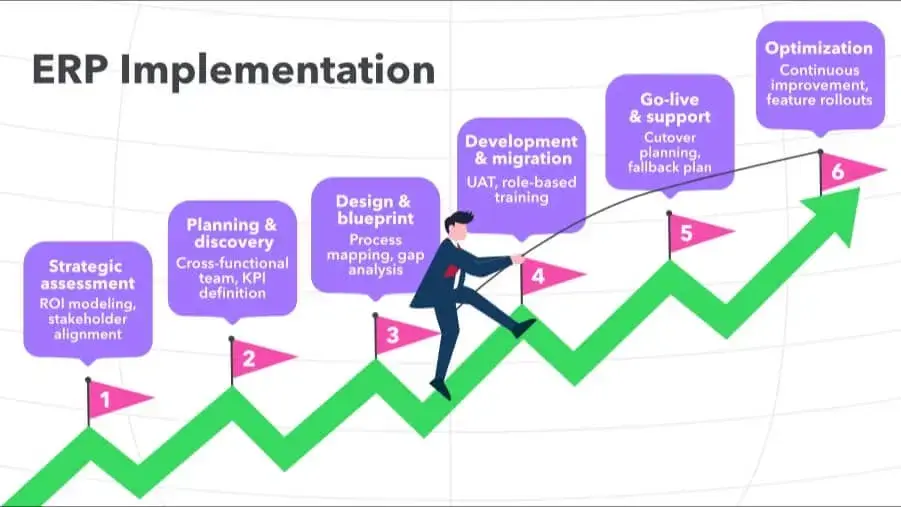
Our Proven ERP Implementation Methodology — Built for PE Speed & Precision

1
🎯

Discovery & PE Alignment

We begin by aligning ERP strategy with your value creation plan, reporting structure, and hold period timeline. This ensures the implementation supports EBITDA growth, portfolio visibility, and exit readiness from day one.

2
💼

ERP Selection Support

Our vendor-agnostic advisory approach helps you select the right ERP platform based on multi-entity complexity, consolidation needs, and scalability requirements — not software partnerships or incentives.

3
📊

Data Strategy & Migration Planning

Before migration begins, we audit, cleanse, and map financial and operational data to ensure integrity. Clean data is critical for accurate portfolio company reporting and due diligence confidence.

4
⚙️

Configuration & Customization

We configure workflows, financial controls, and reporting frameworks aligned with private equity requirements — including multi-entity structures, consolidated dashboards, and investor-level reporting.

5

Testing & Quality Assurance

Through structured system testing and user acceptance validation, we eliminate ERP implementation challenges before go-live. Stability, accuracy, and governance are non-negotiable.

6
🚀

Go-Live & Hypercare Support

During launch, our team provides hands-on stabilization support to ensure finance and operations teams transition smoothly with minimal disruption to performance.

7
📈

Post-Implementation Optimization

After deployment, we refine reporting, automation, and system controls in line with evolving portfolio strategies — ensuring the ERP environment continues to support value creation milestones.

ERP Platforms We Implement for Portfolio Companies

 Every portfolio company has unique operational requirements and no single ERP platform fits every situation. As technology-agnostic ERP implementation consultants, we work across all leading enterprise platforms, recommending and implementing the system that best aligns with your portfolio company's size, complexity, and exit timeline. 

Acumatica

Acumatica

Our preferred cloud based ERP

Avalara

Avalara

Add tax compliance to your tech stack

Tableau

Tableau

Visual analytics for your ERP

JigX

JigX

No-code mobile apps for ERP

VLX

Velixo

Excel reporting, budgeting & automation for ERPs

ProjectManager

ProjectManager

PM for your ERP

AlphaStaff

AlphaStaff

Preferred payroll and PEO partner

bill.com

Bill.com

AP automation for your ERP

ERP Implementation Across PE-Backed Industry Verticals

General Business
  • Financial Management
  • Project Accounting
  • Payroll Management
  • Multi-Entity + Inter-company Accounting
  • Reporting, Dashboards, + Data Analytics
  • Customer Relationship Management (CRM)
Manufacturing
  • Bills of Materials + Routing
  • Production Management
  • Material Requirements Planning (MRP)
  • Advanced Planning + Scheduling
  • Engineering Change Control (ECC)
  • Manufacturing Data Collection (MDC)
  • Product Configurator
  • Manufacturing Estimates
Construction
  • Construction Management
  • General Contractor
  • Home Builder Accounting
  • Subcontractor Accounting
  • Land Developer Accounting
  • Service Management
  • Equipment Management
Distribution
  • Sales Order Management
  • Purchase Order Management
  • Warehouse Management
  • Inventory Management
  • Order Management Software
  • Requisition Management
Retail
  • Commerce Connectors
  • Inventory Management
  • Sales Order Management
  • Reporting, Dashboards, + Data Analytics 
  • Warehouse Management System
  • CRM
All industries

What Customer Say About Our Erp Implementation Services?

In the fast-paced and complex world of private equity, managing acquisitions efficiently while implementing an ERP system can be a formidable challenge. This was precisely the situation our group faced after acquiring three new entities during a critical phase of our ERP implementation process. It was during this crucial juncture

As the former owner of 3Sixty Integrated, a company founded at the forefront of providing comprehensive security solutions, navigating the financial intricacies of our industry was always a paramount concern. Our partnership with AccountAbility marked a turning point, offering us not just financial consulting services, but a roadmap to success.

As the Chief Financial Officer of iCARE, a healthcare organization recently transitioning from its position as a portfolio company of Pine Tree Private Equity, I have had the unique opportunity to oversee our organization’s significant growth and evolution. A critical factor in our successful transition was our partnership with AccountAbility,

Frequently Asked Questions

What is an erp?

Enterprise Resource Planning (ERP) software brings your critical business functions—finance, HR, inventory, CRM—into a unified platform. Whether you’re navigating erp system implementation for litigation, seeking the best ERP for law firms, or improving portfolio company performance, a successful enterprise resource planning implementation enables streamlined operations, faster decisions, and scalable systems.

As a boutique erp implementation consulting firm, AccountAbility helps growing organizations adopt industry-tailored ERP solutions with confidence.

What is ERP implementation and why does it matter for private equity?

ERP implementation is the process of deploying and configuring an enterprise resource planning system into a business's operational and financial infrastructure. For private equity, it matters because a portfolio company's ERP environment directly impacts financial close cycles, reporting accuracy, and exit valuation. A well-implemented ERP system is not just an operational tool, it's a value creation asset that supports every stage of the investment lifecycle.

How long does an ERP implementation take for a portfolio company?

For most PE-backed portfolio companies, a standard implementation takes between 3 and 9 months. Post-merger integrations and multi-entity rollouts may extend beyond that depending on scope and complexity. Our methodology is specifically designed to compress timelines without compromising quality ensuring every go-live decision respects your hold period and value creation window.

How much does ERP implementation cost for PE-backed businesses?

ERP implementation costs typically range from $75,000 to $500,000+ depending on the platform, scope, and level of customization required. The more relevant question for private equity is ROI a properly implemented ERP system delivers measurable returns through faster financial closes, reduced operational costs, and stronger exit valuations. We provide transparent, fixed-fee engagements with no budget surprises.

How long does implementation usually take?

Most projects take between 60 and 120 days. We begin with a thorough review of your current systems, then plan a phased rollout with training to minimize disruption.

How do you implement ERP across multiple portfolio companies?

Multi-entity rollouts require a fundamentally different approach than single-company implementations. We establish a standardized ERP framework unified chart of accounts, consistent reporting structures, and shared workflows deployable across each portfolio company while accommodating individual business requirements. This creates the consolidated reporting infrastructure operating partners need without sacrificing operational flexibility.

What ERP system is best for private equity portfolio companies?

There is no single platform that fits every PE-backed business. The right ERP depends on your portfolio company's size, industry, complexity, and exit timeline. NetSuite leads for multi-entity management and scalability. Sage Intacct excels for mid-market consolidation needs. Microsoft Dynamics 365 suits enterprise-scale operations. Acumatica works well for acquisition-driven growth strategies. We guide you through selection objectively with no vendor bias.


How does ERP implementation improve EBITDA and exit valuations?

A well-implemented ERP improves EBITDA through operational efficiency gains, reduced manual processing costs, and better working capital management. At exit, clean data, standardized reporting, and audit-ready financials accelerate due diligence, build buyer confidence, and support premium valuation multiples. Buyers pay more for businesses they can understand quickly and a well-configured ERP makes that possible.


What happens to our ERP during a post-merger integration?

When a bolt-on acquisition closes, the acquired company typically brings its own ERP environment and data structures. Our post-merger integration service consolidates these environments systematically migrating clean data, standardizing chart of accounts, and unifying reporting structures. The goal is a single, unified ERP environment that reflects the combined business as quickly and cleanly as possible.

How do you ensure ERP go-live doesn't disrupt our portfolio company's operations?

Our approach combines rigorous UAT testing, phased rollout planning, comprehensive user training, and a dedicated hypercare support window. Every go-live is preceded by full data validation and stakeholder sign-off ensuring the business transitions onto the new system with confidence, not operational disruption.


Can you implement ERP within a PE holding period timeline?

Yes and this is precisely what makes our practice different. Every engagement is scoped around your investment timeline. We work backwards from your hold period constraints to deliver a fully operational ERP environment within the time your investment requires — maximizing the return on your ERP investment within your specific value creation window.

Read Our Latest Blog