Skip to content


ERP Software for Professional Services Built for PE-Backed Firms

Professional services firms lose billable revenue daily to disconnected tools, delayed invoicing, and manual reporting. ERP software for professional services consolidates project accounting, resource planning, time tracking, and financial reporting into one system giving firms real-time control over profitability, utilization, and cash flow.

ERP Software for Professional Services Built for PE-Backed Firms partner with acumatica

Trusted by Professional Services Firms Across Every Vertical

acumatica-program_and_certification_badges-2026_-XRP- DEVELOPER
acumatica-program_and_certification_badges-2026_CONSTRUCTION AUTHORIZED-VAR (1)
acumatica-program_and_certification_badges-2026_GOLD CERTIFIED-SERVICES PROVIDER (1)
acumatica-program_and_certification_badges-2026_DISTRIBUTION- AUTHORIZED-VAR


Professional Services Firms Operate Differently Your ERP Should Too


Generic ERP systems are engineered for product-based businesses. Professional services firms managing billable time, project margins, resource utilization, and multi-entity financials operate on fundamentally different requirements. The result: revenue leakage, reporting delays, and zero visibility into project-level profitability.


No Visibility Into Project-Level Profitability

Project-level profitability tracks revenue, cost, and margin per engagement. Generic ERP reports at company level only. Firms running multiple simultaneous engagements lose an average of 18% gross margin annually — invisible losses that compound across every project cycle.

Billing Delays From Disconnected Timesheets

Disconnected timesheet systems break the direct link between time entry and client invoicing. Professional services firms experience invoice delays of 8–14 days per billing cycle directly aging accounts receivable and reducing monthly cash flow.

Manual Revenue Recognition Draining Your Finance Team

Revenue recognition under ASC 606 and IFRS 15 requires percentage-of-completion tracking, milestone adjustments, and deferred revenue entries per engagement. Without automation, finance teams spend 12–15 hours weekly on manual entries — increasing audit risk and misstating project profitability.

No Real-Time View Across Projects, Resources and Cash Flow

Real-time visibility across project accounting, resource utilization, and cash flow requires a single integrated system. Generic ERP delivers reports 5–7 days behind live operational data making accurate decisions across PE-backed portfolios impossible.

Month-End Reporting That Takes Days — Not Minutes

Month-end close in professional services involves WIP reconciliation, intercompany eliminations, and multi-entity consolidation. Firms on generic ERP average 8–12 days to close monthly books. Disconnected systems are the primary cause.

Multi-Entity Structures That Generic ERP Simply Can't Handle

Multi-entity consolidation requires intercompany accounting, multi-currency translation, and portfolio-level reporting across all operating entities. Generic ERP requires $45,000–$120,000 in custom development to support basic multi-entity structures a cost PE-backed firms absorb repeatedly without resolution.

Construction ERP Software by erp for private equity

One ERP Platform Built for Professional Services

Professional services firms manage a business model that generic ERP ignores billable time, project margins, multi-entity structures, and investor-grade reporting. ERP for Professional Services, powered by Acumatica, addresses each of these directly. Consulting, IT, legal, and PE-backed service firms gain real-time project profitability, automated revenue recognition, and consolidated financial visibility without customization, workarounds, or disconnected tools.

How It Works — ERP for Professional Services
Implementation Process

From Day One to Full Visibility —
Here's How It Works

Professional services ERP implementation follows three structured phases — each delivering measurable operational improvement before the next begins.

 
Step 01

Connect Projects, People and Finances in One Place

Acumatica ERP centralizes project accounting, resource allocation, timesheet management, and general ledger into one system. Every billable hour and project cost flows into a single data source — eliminating manual reconciliation.

1
🔗 Unified Data Source

Project Accounting · Resource Planning · General Ledger · Timesheet Management

Step 02

Get Real-Time Visibility Across Billing, Utilization and Profitability

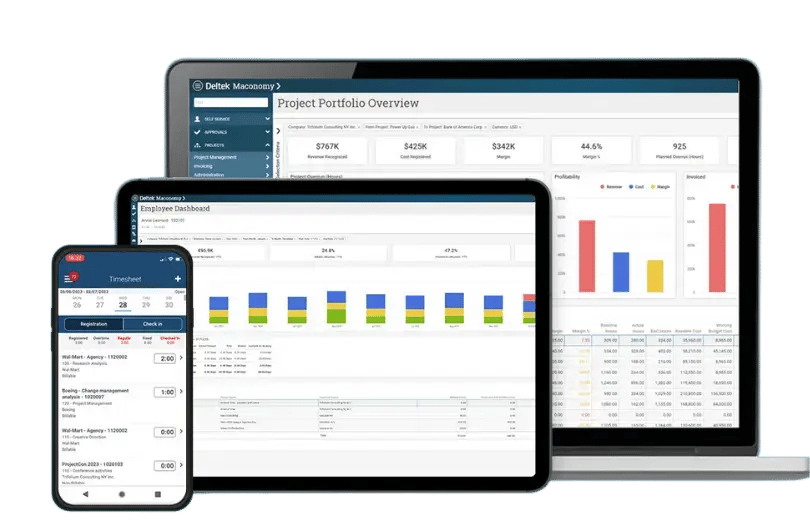
Real-time dashboards surface project-level profitability, resource utilization rates, and cash flow — updated live. PE-backed firms access consolidated financial data across every portfolio entity from one interface.

2
📊 Live Visibility

Utilization Rates · Billing Pipeline · Project Profitability · Cash Flow Position

Step 03

Close Faster, Report Smarter and Scale Without Chaos

Automated workflows handle WIP reconciliation, ASC 606 revenue recognition, and multi-entity consolidation — reducing month-end close from 8–12 days to 2–3 days. Finance teams scale reporting without adding headcount.

3
Faster Close

WIP Reconciliation · ASC 606 · Intercompany Eliminations · Multi-Entity Consolidation


Everything Your Professional Services Firm Needs — In One Platform

 Acumatica ERP consolidates project accounting, resource planning, and revenue recognition into a single cloud platform — built for PE-backed professional services firms managing complex, multi-entity operations. 

Project Accounting & Billing

Manage project billing, milestone invoicing, and retainer contracts from one unified ledger. Acumatica's project billing ERP eliminates revenue leakage by connecting every billable event — time entries, expenses, and deliverables — directly to client invoices and the general ledger.

Time & Expense Management

Capture billable hours and reimbursable expenses with precision using integrated timesheet software. Mobile-friendly time entry, automated approval workflows, and real-time billable hours tracking ensure every revenue-generating hour reaches the invoice.

Resource Planning & Utilization

Maximize billable capacity with real-time utilization tracking and forward-looking capacity planning. Assign the right resource to the right project, monitor utilization rates by team or individual, and prevent revenue loss from under-staffed or over-committed engagements.

Revenue Recognition & Compliance

Automate ASC 606-compliant revenue recognition across fixed-fee, time-and-materials, and milestone-based contracts. Manage deferred revenue schedules, WIP adjustments, and financial compliance reporting without manual journal entries or spreadsheet workarounds.

Financial Reporting & Dashboards

Access real-time P&L by project, client, or business unit. Configurable KPI dashboards surface cash flow position, billing pipeline, and margin performance giving finance leaders the visibility needed to act before month-end close.

Multi-Entity & Consolidated Financials

Run intercompany accounting, shared services allocation, and consolidated financial reporting across every portfolio entity from one platform. Multi-entity ERP eliminates manual consolidation and accelerates reporting for PE sponsors and CFOs managing multiple operating companies.

Why Choose us ERP for Professional Services ? 

ERP for Private Equity, built on Acumatica, is engineered specifically for professional services firms delivering native project accounting, billable utilization tracking, and investor-grade reporting without customization or workarounds.

  • PE-Grade Portfolio Visibility — Real-time P&L, intercompany transactions, and LP-ready dashboards across every operating entity from one interface.
  • Configurable Without Development — Billing workflows, revenue schedules, and approval chains adapt to your delivery model.
  • Implementation in 8–12 Weeks — Structured across discovery, configuration, data migration, and go-live not the industry-standard 14–18 months.
  • Dedicated Industry Support — Implementation specialists with direct experience in project accounting, utilization economics, and PE reporting not generalist helpdesk staff.
why Choose erp for pivate equity ERP for Professional Services

What Customer Say About Our Services?

 We were losing billable hours to manual timesheet reconciliation and disconnected project billing. ERP for Private Equity gave us real-time utilization tracking and milestone billing in one platform — our realization rate improved by 18% within the first quarter. 

 Managing six portfolio companies on separate systems made consolidated reporting a nightmare. ERP for Private Equity's intercompany accounting and live KPI dashboards gave our operating partners and LP reporting team a single source of truth finally. 

 Before ERP for Private Equity, our month-end close took nearly two weeks across four entities. Now we consolidate financials in under three days. The multi-entity reporting and ASC 606 automation alone justified the entire implementation. 

Ready to Run Your Firm With Full Visibility and Control?

Professional services firms using ERP for Private Equity, built on Acumatica, close books faster, recover billable revenue, and maintain real-time visibility across every project, entity, and portfolio investment.

Frequently Asked Questions

What is ERP software for professional services?

 ERP software for professional services is an integrated platform that manages project accounting, resource planning, billing, time and expense tracking, and financial reporting in one system. Unlike generic ERP, it is purpose-built for service-led businesses where revenue is tied to people, projects, and contracts not inventory or manufacturing. 

How is professional services ERP different from generic ERP?

 Generic ERP is designed around product-based workflows — inventory, procurement, and manufacturing. Professional services ERP is built around project profitability, billable utilization, milestone billing, and ASC 606 revenue recognition. ERP for Private Equity extends this further with multi-entity consolidation and PE-grade financial reporting built in from day one. 

How long does ERP implementation take for a service firm?

 A typical professional services ERP implementation takes 3 to 6 months depending on entity complexity, data migration scope, and integration requirements. PE-backed firms with multiple portfolio companies may require a phased rollout. ERP for Private Equity follows a structured three-phase implementation — each phase delivering measurable operational improvement before the next begins. 

How much does ERP software cost for professional services firms?

Pricing depends on the number of users, entities, and modules required. Acumatica — the platform behind ERP for Private Equity — is licensed on a consumption-based model rather than per-user pricing, making it cost-effective as your headcount scales. Contact ERP for Private Equity for a scoped estimate aligned to your firm's size and structure.

Is it suitable for PE-backed or multi-entity businesses?

 Yes. ERP for Private Equity is specifically designed for PE-backed portfolio companies and multi-entity professional services firms. It supports intercompany accounting, shared services allocation, consolidated financial reporting, and LP-ready dashboards — giving PE sponsors and CFOs a single source of truth across every operating entity. 

Can ERP and CRM be used together for professional services?

Yes. ERP for Private Equity integrates natively with Salesforce and supports pipeline-to-project workflows within the platform. Opportunity data, proposal management, and contract values flow directly into project setup and billing eliminating re-entry between business development and finance teams.

What integrations are supported?

 ERP for Private Equity supports native integrations with Salesforce, QuickBooks, and leading payroll and PSA platforms. Its open API enables bidirectional data sync with your existing tech stack including HRIS, project management, and business intelligence tools without costly middleware. 

How is data security and compliance handled?

 Acumatica is hosted on AWS and Microsoft Azure with SOC 1 and SOC 2 Type II certification. Role-based access controls, full audit trails, data encryption at rest and in transit, and automated backups are standard. For PE-backed firms, compliance reporting and multi-entity audit trails are built into the platform — supporting both internal controls and external audit requirements. 

Read Our Latest Blog