
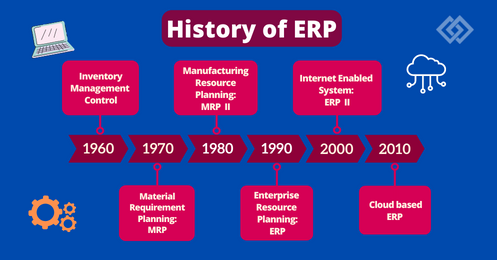
Cloud ERP is enterprise software that runs core finance and operations processes over the internet on a vendor-managed platform. Its history spans seven stages: manufacturing planning systems, integrated business suites, web-hosted applications, internet-extended systems, cloud delivery, shared multi-tenant platforms and embedded automation. Each stage changed cost, speed and scalability for buyers. Private equity firms use this history to select systems that standardize portfolio reporting and support exit readiness.
MRP Systems Automate Manufacturing Planning (1960s–1980s)
MRP systems automated manufacturing planning from 1964, when IBM engineer Joseph Orlicky developed material requirements planning, to 1983, when Oliver Wight extended it into MRP II. The objectives of an MRP system are listed below:
- Ensure raw material availability for production and delivery
- Maintain minimal material and product inventory levels
- Plan manufacturing activities, delivery schedules and purchasing
According to Wikipedia, 700 companies had implemented MRP by 1975. MRP II software represented about one third of the software industry in 1989, with $1.2 billion sold to American industry.
What Is Material Requirements Planning?
Material requirements planning (MRP) is a production planning, scheduling and inventory control system that calculates material quantities and delivery timing from bills of material, inventory data and the master production schedule. Orlicky formalized MRP after studying the Toyota Production System, according to slm.mba.
Why Did Early Systems Run Only On-Premise?
Early systems ran only on-premise because vendors delivered software for company-owned mainframes, as SAP R/2, a mainframe-based suite popular in the 1980s and early 1990s, shows. Wikipedia records that R/2 served large multinational European companies.
Integrated ERP Suites Unify Business Functions (1990s)
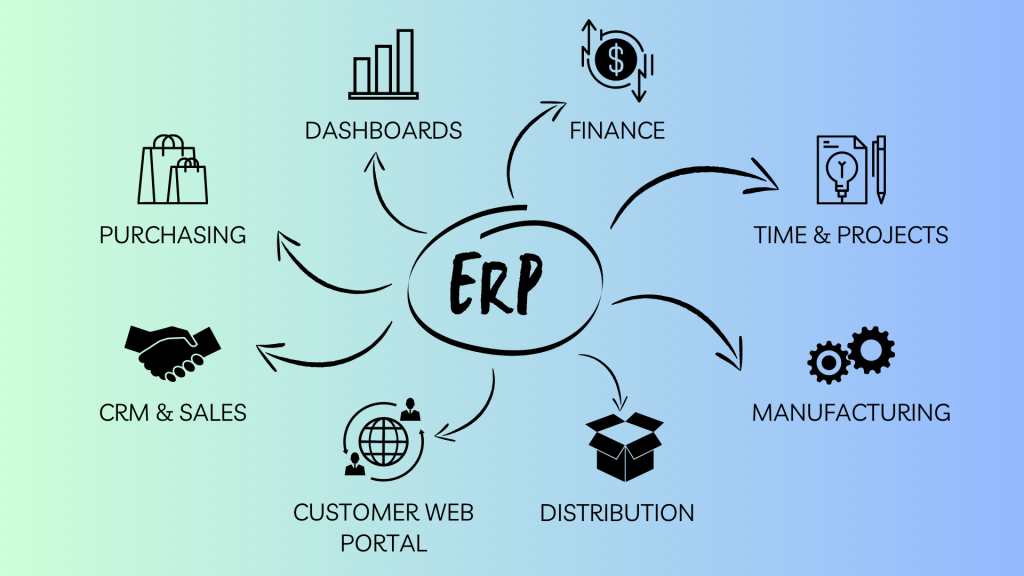
Integrated ERP suites unified business functions in the 1990s, beginning when Gartner coined the term ERP in 1990 and SAP launched R/3 on 6 July 1992. The characteristics of 1990s ERP suites are listed below:
- Share one central database across functions
- Integrate finance, human resources and operations modules
- Run on three-tier client-server architecture
- Replace in-house systems with off-the-shelf packages
An academic chapter on enterprise systems cites a 1998 survey (Caldwell and Stein) showing that about 40% of companies with revenue above $1 billion had implemented ERP by 1998. The same chapter cites Thomas Davenport’s 1998 Harvard Business Review analysis, which valued the enterprise system industry at $10 billion and SAP’s 1997 revenue at $3.3 billion. E2b technologies attributes the 1990s surge to the introduction of the Euro and the Y2K problem.
When Did the Term ERP Emerge?
The term ERP emerged in 1990, when Gartner coined it to extend MRP II with back-office functions including finance, human resources and order management, according to Xledger. By the mid-1990s, suppliers included SAP, Oracle and JD Edwards, according to Visibility ERP.
What Limited Client-Server ERP Suites?
Rigid business logic and implementation risk limited client-server ERP suites, according to Davenport’s 1998 Harvard Business Review analysis, which found that enterprise systems impose their own logic on company strategy, organization and culture. Davenport cited FoxMeyer Drug, which attributed its bankruptcy partly to its system.
Web-Hosted ERP Introduces Software-as-a-Service (1998–2005)
Web-hosted ERP introduced software-as-a-service between 1998 and 2005, beginning when Evan Goldberg incorporated NetSuite in California in September 1998, according to NetSuite’s SEC filing. Oracle chairman Larry Ellison provided seed money, according to Wikipedia. The characteristics of web-hosted ERP are listed below:
- Sell software over the internet
- Host infrastructure at the vendor
- Start with web-hosted accounting
- Target firms below 1,000 employees
According to Wikipedia, NetSuite listed on the NYSE in December 2007 with a 6.2 million-share IPO.
Who Launched the First Web-Hosted ERP?
NetSuite, founded as NetLedger by Evan Goldberg in 1998, is often cited as the first cloud software company, and its web-hosted accounting product became NetSuite ERP about five years later, according to NetSuite.
How Does Hosted ERP Differ From True Cloud ERP?
Hosted ERP differs from true cloud ERP in architecture: hosted ERP runs on-premises software in an external data center, whereas true cloud ERP runs on a vendor-managed, multi-tenant platform. TechTarget reports that private cloud options spare owners most maintenance but do not match the innovation pace of SaaS.
ERP II Extends Business Systems Across the Internet (2000s)
ERP II extended business systems across the internet in the 2000s, when Gartner introduced the term around 2000 for web-based ERP with real-time access. The characteristics of ERP II are listed below:
- Extend access to employees, suppliers and customers
- Deliver real-time information
- Add CRM, ecommerce and supplier relationship functions
- Interact with other systems
Xledger reports that an increasing number of clients migrated ERP to the cloud from 2000 on.
What Is ERP II?
ERP II is Gartner’s 2000 term for web-based ERP that gives employees, suppliers and customers real-time access to enterprise data, according to e2b teknologies.
Why Did Internet Access Change ERP Delivery?
Internet access changed ERP delivery because inexpensive web connectivity enabled vendor-hosted software. TechTarget reports that nearly all significant ERP trends since the early 2000s depended on it.
Cloud ERP Replaces On-Premise Infrastructure (2010–2016)
Cloud ERP replaced on-premise infrastructure between 2010 and 2016, when, according to SYSPRO, internet technologies reached the cloud and businesses moved entire infrastructures into it. The characteristics of this stage are listed below:
- Shift infrastructure to vendor platforms
- Replace license purchases with subscriptions
- Link core ERP with cloud applications
- Acquire cloud ERP providers
Acumatica illustrates mid-market platforms of this stage: according to Wikipedia, it introduced its ERP product in 2008, added on-premises and SaaS versions in 2009 and launched its xRP cloud platform in 2014.
When Did Cloud ERP Become Mainstream?
Cloud ERP became mainstream in the 2010s, when web technologies matured enough for companies to move entire infrastructures into the cloud, according to SYSPRO. Gartner research showed 72% of polled companies ran hybrid ERP environments by 2014.
What Is Postmodern ERP?
Postmodern ERP is a Gartner strategy introduced between 2013 and 2014 that links business capabilities through appropriate integration levels instead of one monolithic suite, according to Xledger.
Why Did Large Vendors Acquire Cloud ERP Providers?
Large vendors acquired cloud ERP providers to compete with cloud rivals, as Oracle did when it announced a $9.3 billion offer ($109 per share) for NetSuite on 28 July 2016 and closed the deal on 7 November 2016. Berkeley Law’s reporting names Workday and Salesforce as the rivals. NetSuite served 30,000 customers in more than 100 countries, according to BSIC. SAP announced S/4HANA on 3 February 2015, which Constellation Research describes as SAP’s largest product announcement since R/3 in 1992.
Multi-Tenant Platforms Standardize Real-Time Reporting (2016–2022)
Multi-tenant platforms standardized real-time reporting between 2016 and 2022, as vendors ran many customers on one maintained platform. In 2019, Gartner introduced Enterprise Business Capabilities, which moved ERP away from the center of the enterprise, according to SAP. The characteristics of this stage are listed below:
- Run customers on one vendor-managed platform
- Display role-specific, real-time dashboards
- Consolidate entities in real time
- Compose modular capabilities through APIs
What Is Multi-Tenant Cloud ERP?
Multi-tenant cloud ERP is a vendor-managed platform that serves many customers from one shared system, according to NetSuite, which develops one multi-tenant cloud platform.
How Did Shared Platforms Change Portfolio Reporting?
Shared platforms enabled real-time multi-entity consolidation. NetSuite’s private equity ebook states that PE-backed companies grow by acquisition and tolerate no delayed or inaccurate financial reporting. Western Computer reports that one PE-backed organization standardized over 100 operating companies on Business Central in under 12 months.
AI-Embedded ERP Automates Financial Decisions (2020s–Present)
AI-embedded ERP automates financial decisions in the 2020s, a decade in which NetSuite’s ERP timeline places AI across ERP systems, according to slm.mba. The characteristics of AI-embedded ERP are listed below:
- Predict outcomes
- Automate decisions
- Orchestrate operations
- Embed natural-language workflows
The Business Research Company attributes market growth to AI-driven ERP modules and digital finance adoption.
What Does AI-Embedded ERP Do?
AI-embedded ERP predicts outcomes, automates decisions and orchestrates operations instead of only recording transactions, according to slm.mba. Fortune Business Insights adds that generative AI raises efficiency and real-time insight.
What Is Composable ERP?
Composable ERP is a modular, API-connected cloud architecture that lets businesses assemble and reassemble capabilities as needs change, according to SAP. Straits Research lists modular and composable architectures as a market trend.
What Limits Customization in Cloud ERP?
Shared multi-tenant code limits customization in cloud ERP, and Fortune Business Insights lists limited customization, compared with on-premise models, as a restraint on market growth.
How Did the Cloud ERP Market Evolve for Private Equity Portfolios?
The cloud ERP market evolved from web-hosted accounting software in 1998 into a USD 65–98 billion category in 2025, and private equity portfolios use it for real-time consolidation across acquired companies.
What Is the Cloud ERP Market Size?
The cloud ERP market was valued at USD 65.24 billion to USD 98.32 billion in 2025, depending on the research firm. The figures by firm are listed in the table below:
|
Research firm |
2025 |
2026 |
Projection |
CAGR |
|
Straits Research |
USD 65.24 billion |
USD 74.31 billion |
USD 210.49 billion (2034) |
13.90% |
|
Fortune Business Insights |
USD 65.89 billion |
USD 76.17 billion |
USD 207.59 billion (2034) |
13.40% |
|
The Business Research Company |
USD 98.32 billion |
USD 113.94 billion |
Above USD 202 billion (2030) |
15.9% |
From the small and mid-sized business perspective, The Business Research Company attributes about 2.3% annual market growth to SME adoption.
Which Regions Lead Cloud ERP Adoption?
North America leads cloud ERP adoption with a 36.02% share in 2025, according to Straits Research. Fortune Business Insights reports 36.10% and projects the highest growth for Asia Pacific. Fortune also reports that enterprises hold 58.41% of the market in 2026.
What Are the Types of Cloud ERP Deployment?
Cloud ERP deployment has three types: public cloud, private cloud and hybrid cloud, according to Fortune Business Insights. The types of cloud ERP deployment are listed below:
- Public cloud runs customers on a vendor-managed, multi-tenant platform.
- Private cloud runs on-premises software in an external data center, according to TechTarget.
- Hybrid cloud combines on-premise and cloud components, and 72% of companies polled by Gartner ran hybrid environments by 2014.
What Is the Difference Between Cloud and On-Premise ERP?
Cloud ERP differs from on-premise ERP in hosting, upfront cost, implementation duration, upgrades and customization, as the table below shows.
|
Factor |
Cloud ERP |
On-premise ERP |
|
Hosting |
Vendor-managed, multi-tenant platform |
Customer-owned infrastructure |
|
Upfront cost |
Removes heavy upfront capital expenditure |
Requires hardware and license spending |
|
Implementation duration |
11.6 months for SaaS (Panorama, 2010) |
18.4 months (Panorama, 2010) |
|
Upgrades |
Vendor-managed |
Customer-managed |
|
Customization |
Limited by the shared platform |
Extensive |
Which Cloud ERP Benefits Matter Most to Private Equity Firms?
The cloud ERP benefits that matter most to private equity firms are real-time consolidation, accurate financial reporting and acquisition scalability, according to NetSuite’s private equity ebook. The benefits are listed below:
- Consolidate portfolio entities in real time
- Deliver accurate, timely financial reporting
- Support growth by acquisition
- Standardize reporting across operating companies
- Prepare audit-ready reporting for exit
From the exit perspective, Western Computer states that standardized portfolio finance produces audit-ready reporting that supports valuation outcomes.
How Long Does Cloud ERP Implementation Take?
Cloud ERP implementation takes 3 to 9 months for small and mid-sized businesses and 6 to 18 months for large enterprises, according to NetSuite. Three to nine months equals about 13 to 39 weeks. Panorama’s 2010 report records 11.6 months for SaaS and 18.4 months for on-premise ERP. VJM Global reports a 15.5-month median across ERP deployments in Panorama’s 2023 report and states that cloud ERP removes hardware procurement, which shortens timelines by weeks to months.
Is Cloud ERP Replacing On-Premise ERP?
Yes, cloud ERP is replacing on-premise ERP gradually, as the cloud market grows from USD 65.24 billion in 2025 to a projected USD 210.49 billion by 2034, according to Straits Research. SYSPRO states that on-premise applications are by no means dead.
Is Cloud ERP Suitable for Portfolio Companies?
Yes, cloud ERP suits portfolio companies because it consolidates entities in real time and supports acquisition-driven growth, according to NetSuite’s private equity ebook. Straits Research lists data governance restrictions and skill gaps as adoption restraints.