
Public Cloud vs. Private Cloud ERP: Which Fits Your Business?
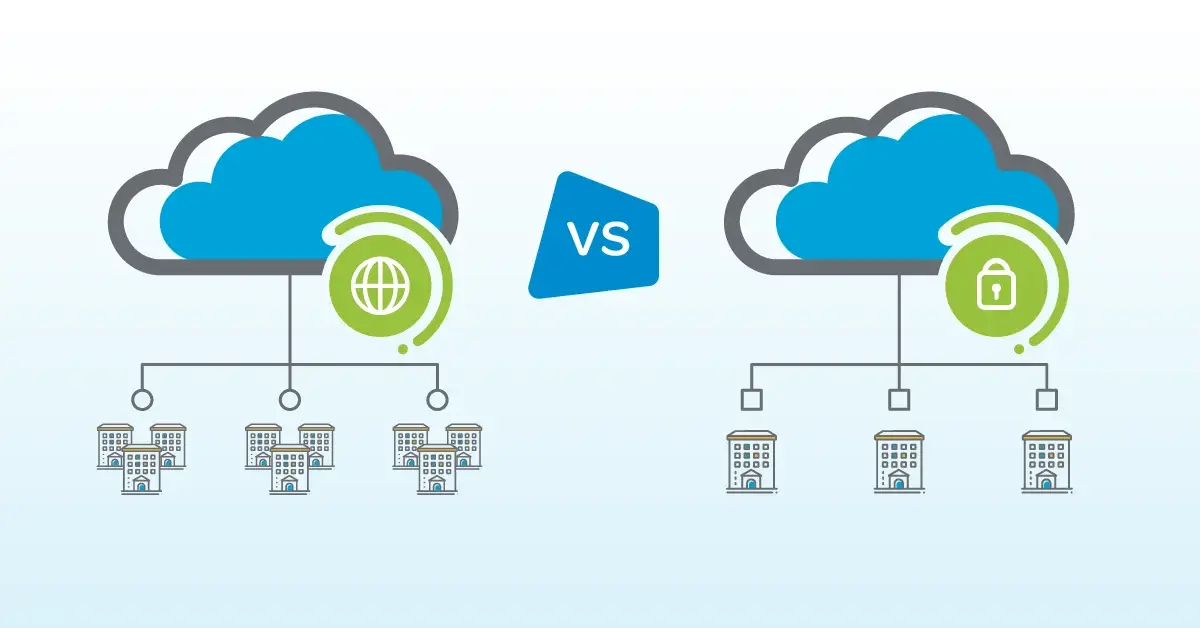
Public cloud ERP runs on shared infrastructure serving multiple organizations; private cloud ERP runs on dedicated infrastructure reserved for one. That's the core distinction.
Neither model is universally better the right fit depends on compliance, budget, and control needs. Retailers with light regulatory burden often suit public cloud, gaining lower costs and faster deployment. Healthcare and financial firms handling sensitive data often need private cloud, trading cost for tighter data isolation.
This guide compares both across cost, security, customization, speed, and scalability, then outlines which scenarios favor each.
What Is Public Cloud ERP?
Public cloud ERP is an ERP system hosted on shared infrastructure owned by the vendor, serving multiple organizations at once. Each organization's data stays isolated, despite running on common servers.
This model typically runs as multi-tenant SaaS, where one software version supports many customers through a shared codebase, letting the vendor spread infrastructure costs across its full customer base. That shared-resource structure is why public cloud ERP generally costs less and deploys faster than other models.
Public cloud ERP suits businesses without heavy regulatory burdens, since shared-server data isolation meets most standard compliance needs.
What Is Private Cloud ERP?
Private cloud ERP is an ERP system hosted on dedicated infrastructure reserved for a single organization. No other company shares the same servers or software instance.
This model runs as a single-tenant deployment, hosted by the vendor or a third party exclusively for one customer, giving that organization its own isolated environment rather than a shared codebase. That dedicated structure is why private cloud ERP generally costs more and takes longer to deploy than public cloud.
Private cloud ERP suits businesses with strict regulatory or compliance requirements, since exclusive infrastructure gives tighter control over data isolation.
Public Cloud vs. Private Cloud ERP: Key Differences
Cost Differences
Public cloud ERP costs less than private cloud ERP, typically 20–30% lower over a system's lifecycle. Shared infrastructure spreads server and maintenance costs across all customers, while private cloud dedicates servers to one organization, raising the price per user. Public cloud also removes upfront hardware costs entirely, since the vendor owns all infrastructure.
Security and Data Control Differences
Private cloud ERP gives tighter data control than public cloud ERP, through dedicated, isolated infrastructure. No other organization shares the same servers, reducing exposure in high-compliance environments. Public cloud ERP still isolates each customer's data on shared servers, meeting standard security needs for most businesses without strict regulatory requirements.
Customization Differences
Private cloud ERP allows deeper customization than public cloud ERP, since dedicated infrastructure isn't constrained by a shared codebase. Multi-tenant public cloud systems limit configuration to existing settings and fields across all customers. Private cloud deployments support custom workflows, integrations, and code-level changes suited to specialized business processes.
Implementation Speed Differences
Public cloud ERP deploys faster than private cloud ERP, often in weeks rather than months. Shared, pre-built infrastructure requires no dedicated server setup before go-live. Private cloud implementations take longer, since dedicated infrastructure must be provisioned and configured for a single organization before deployment begins.
Scalability Differences
Public cloud ERP scales faster than private cloud ERP, adding users or storage instantly through shared infrastructure. Private cloud scaling requires provisioning additional dedicated capacity, adding time and cost. Businesses with unpredictable or rapid growth generally scale more efficiently on public cloud than on a fixed private infrastructure.
Comparison Table: Public Cloud vs. Private Cloud ERP
| Factor | Public Cloud ERP | Private Cloud ERP |
|---|---|---|
| Infrastructure | Shared servers across multiple organizations | Dedicated servers for one organization |
| Cost | 20–30% lower over system lifecycle | Higher due to dedicated infrastructure |
| Deployment speed | Weeks, using pre-built shared infrastructure | Months, requiring provisioned infrastructure |
| Security and data control | Isolated data on shared servers | Exclusive infrastructure, tighter isolation |
| Customization | Limited to shared codebase settings | Deep, code-level customization supported |
| Scalability | Instant, through shared resources | Requires provisioning additional capacity |
| Best fit | Businesses with light compliance needs | Regulated industries, complex requirements |
| Common model | Multi-tenant SaaS | Single-tenant deployment |
When to Choose Public Cloud ERP
Public cloud ERP fits businesses that:
- Operate as a small or mid-sized business with limited IT staff
- Face budget constraints requiring lower upfront and ongoing costs
- Carry no heavy compliance or data residency burden
- Need instant scalability to support fast growth
- Require production-ready deployment within weeks
When to Choose Private Cloud ERP
Private cloud ERP fits businesses that:
- Operate in a regulated industry, such as healthcare or finance
- Need complex, code-level customization beyond standard configuration
- Maintain a dedicated in-house IT team to manage infrastructure
- Face data residency requirements tied to specific jurisdictions
- Prioritize exclusive infrastructure over lower cost or faster deployment
Can You Switch Between Public and Private Cloud ERP Later?
Yes, businesses can switch between public and private cloud ERP. Migration involves transferring data, reconfiguring integrations, and retraining staff on the new environment, similar to any cloud ERP migration process.
Businesses starting on public cloud for cost and speed often move to private cloud later, once compliance requirements or customization needs grow beyond what shared infrastructure supports. For a full breakdown of the migration process and deployment models, see Types of Cloud ERP.
Frequently Asked Questions
Is Private Cloud ERP Always More Secure Than Public Cloud?
No, private cloud ERP is not always more secure than public cloud ERP. Both models use vendor-managed encryption and access controls. Private cloud adds isolation through dedicated infrastructure, which reduces exposure in specific compliance scenarios, but public cloud vendors maintain equivalent security standards, including SOC 2 and GDPR compliance, for the vast majority of businesses.
Does Private Cloud ERP Cost Significantly More Than Public Cloud?
Yes, private cloud ERP costs significantly more than public cloud ERP. Dedicated infrastructure typically raises costs by 20–30% compared to shared, multi-tenant systems. This price difference reflects exclusive server resources, custom configuration, and lower economies of scale versus a vendor's shared customer base.
Can a Mid-Sized Business Use Private Cloud ERP?
Yes, a mid-sized business can use private cloud ERP. Eligibility depends on need, not company size. Mid-sized businesses in regulated industries, or those requiring deep customization, commonly adopt private cloud despite the higher cost, while mid-sized businesses without compliance pressure typically choose public cloud instead.
What Industries Typically Require Private Cloud ERP?
Industries that typically require private cloud ERP include:
- Healthcare, due to HIPAA compliance requirements
- Financial services, due to strict data security regulations
- Government agencies, due to data residency mandates
- Legal services, due to client confidentiality requirements
- Defense and aerospace, due to national security data controls
Conclusion
Public cloud ERP and private cloud ERP differ in infrastructure ownership, not in overall quality. Public cloud runs on shared servers, offering lower cost and faster deployment. Private cloud runs on dedicated infrastructure, offering tighter data control and deeper customization. Neither model outperforms the other universally — the right choice depends on compliance obligations, budget, and the level of control a business requires.
Businesses without heavy regulatory burden generally benefit from public cloud ERP, gaining scalability and cost efficiency without dedicated infrastructure overhead. Organizations in regulated industries, or those with complex customization needs, typically justify the added cost of private cloud ERP through stronger data isolation and compliance alignment.
A business's needs can change over time. Companies that start on public cloud for speed and affordability may migrate to private cloud as compliance requirements grow, while those with early customization demands may find public cloud sufficient as their processes standardize. Evaluating current requirements against future growth, rather than defaulting to one model, leads to the most sustainable deployment decision.