
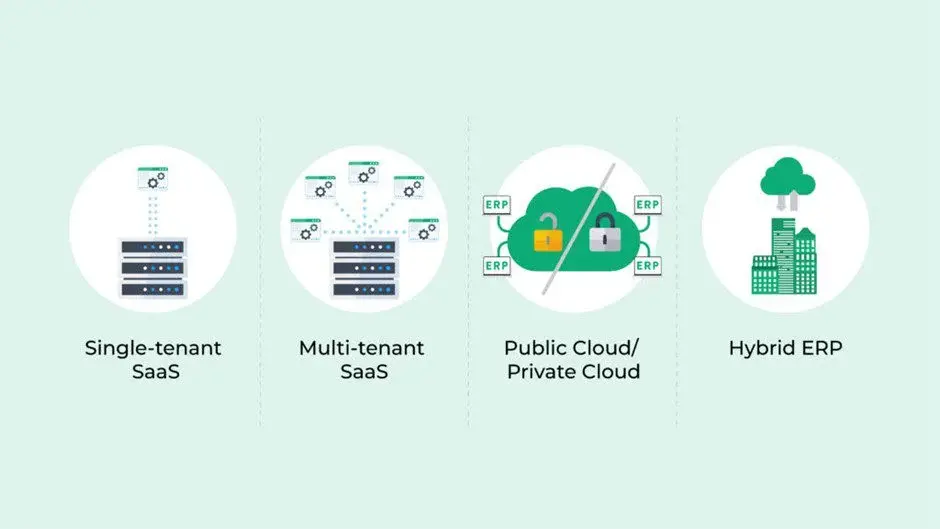
Types of Cloud ERP: Which Deployment Model Is Right for Your Business?
Cloud ERP has four deployment models: public cloud, private cloud, hybrid cloud, and the multi-tenant or single-tenant architecture underneath each one. Four factors decide which model fits a business: company size, compliance requirements, IT team capacity, and budget structure.
Public cloud ERP suits growing businesses with limited IT staff, since it costs less and deploys faster. Private cloud ERP suits regulated or complex organizations, since it adds infrastructure control. Hybrid cloud ERP suits companies with existing on-premise systems, since it connects both environments. Multi-tenant and single-tenant architecture sits beneath these three models and sets how infrastructure, cost, and customization scale within each one.
This guide compares each deployment model, then outlines the questions to ask before choosing one.
What Determines the Right Cloud ERP Deployment Model for Your Business
Four factors determine the right cloud ERP deployment model: company size, compliance requirements, IT resource availability, and budget structure. A small business weighs cost and setup speed. A regulated enterprise weighs data control and audit requirements. A company with legacy systems weighs integration over a clean-slate deployment. These factors map directly onto the three deployment models below, and onto the tenancy architecture that underlies them.
Public Cloud ERP
Public cloud ERP is a shared-infrastructure model where multiple customers run on the same vendor-maintained servers. It suits growing businesses, since it lowers upfront cost and shortens implementation time. The vendor handles hosting, updates, and security, removing the need for an in-house infrastructure team. Pricing follows a subscription model, so cost scales with users, not hardware, the same low-overhead structure that private cloud trades away for greater control.
Private Cloud ERP
Private cloud ERP is a dedicated-infrastructure model where one customer runs on isolated servers, either vendor-hosted or self-hosted. It suits regulated or complex organizations, since it adds control over data location, security configuration, and compliance posture. Customization extends further than public cloud allows, because the infrastructure isn't shared across tenants. Cost runs higher, reflecting those dedicated resources a trade-off some companies avoid entirely by splitting workloads between cloud and existing systems instead.
Hybrid Cloud ERP
Hybrid cloud ERP is a combined model that connects cloud-based systems with existing on-premise infrastructure. It suits companies that need to retain legacy systems while adopting cloud capabilities elsewhere. Data and workloads move between the two environments based on compliance, performance, or cost requirements. Migration happens in phases, not as a single cutover, a flexibility that stems from the same tenancy choices driving public and private clouds underneath it.
Multi-Tenant vs. Single-Tenant ERP
Multi-tenant and single-tenant are the two architecture models underneath every cloud ERP deployment. Multi-tenant architecture runs multiple customers on shared infrastructure and a shared software instance the model public cloud ERP uses. Single-tenant architecture runs one customer on dedicated infrastructure and a dedicated instance the model private cloud ERP uses. Multi-tenant architecture lowers cost and speeds up updates, since the vendor maintains one instance for every customer. Single-tenant architecture raises cost and slows updates, since each instance is maintained separately, but it increases control over configuration and data isolation.
Compare the Different Types of Cloud ERP at a Glance
Cloud ERP splits into five comparison points: cost, customization, control, and typical buyer, mapped across four deployment models.
| Type | Best For | Cost | Customization | Control | Typical Buyer |
|---|---|---|---|---|---|
| Public Cloud ERP | Growing businesses with limited IT staff | Lower, subscription-based | Limited, shared instance | Vendor-managed | Small to mid-sized businesses |
| Private Cloud ERP | Regulated or complex organizations | Higher, dedicated infrastructure | Extensive, isolated instance | Customer-managed or co-managed | Enterprises, regulated industries |
| Hybrid Cloud ERP | Companies with existing on-premise systems | Variable, split across environments | Moderate to high, depends on split | Shared between vendor and customer | Mid-sized to large businesses with legacy investments |
| Multi-Tenant Architecture | Businesses prioritizing cost and speed | Lower, shared per-instance cost | Limited by shared codebase | Vendor-managed updates | Public cloud ERP buyers |
| Single-Tenant Architecture | Businesses prioritizing isolation and control | Higher, dedicated per-instance cost | Extensive, independent of other tenants | Customer-managed configuration | Private cloud ERP buyers |
Public cloud and private cloud sit at opposite ends of a cost-versus-control trade-off. Hybrid cloud splits workloads between both, based on compliance, performance, or legacy system requirements. Multi-tenant architecture drives that trade-off on the low-cost end; single-tenant architecture drives it on the high-control end.
How to Choose the Right Type of Cloud ERP for Your Business
Four questions narrow down the right cloud ERP deployment model: company size, compliance requirements, IT team capacity, and growth trajectory.
Company size sets the baseline. A small or mid-sized business with a lean team fits public cloud ERP, since it removes the need for dedicated infrastructure staff. A large or complex organization fits private cloud ERP instead, since it has the resources to manage dedicated infrastructure and that same resource gap carries into the next question.
Compliance requirements narrow the choice further. An organization in a regulated industry healthcare, finance, government contracting needs the data control and audit trail that private or hybrid cloud ERP provides. An organization without heavy regulatory exposure keeps the flexibility to choose on cost alone, which is where IT capacity becomes the deciding factor.
IT team capacity determines how much infrastructure management a company can absorb internally. A company without an infrastructure team benefits from the vendor-managed model public cloud ERP provides. A company with an established IT function can take on the configuration control that private or hybrid cloud ERP requires — control that matters most once growth enters the picture.
Growth trajectory affects long-term fit. A company scaling users and locations quickly benefits from the flexible, subscription-based scaling of public cloud ERP. A company expanding into new regulatory environments, or retaining legacy systems during that expansion, benefits from the added control of hybrid or private cloud ERP.
These four questions settle deployment type. Matching that type to a specific platform is a separate step see How to Choose the Right Cloud ERP Platform for the full selection framework.
Frequently Asked Questions
Is public cloud ERP secure enough for financial data?
Yes, public cloud ERP is secure enough for financial data when the vendor meets recognized security standards. Vendors typically provide:
- Data encryption in transit and at rest
- SOC 2 compliance certification
- Role-based access controls
- Automated backups and disaster recovery
Security responsibility splits between vendor and customer: the vendor secures the infrastructure, while the customer manages user permissions and data entry practices.
What's the difference between SaaS ERP and hosted ERP?
SaaS ERP runs on shared, vendor-managed infrastructure; hosted ERP runs on dedicated servers managed by a third party. SaaS ERP uses multi-tenant architecture, where multiple customers share one software instance. Hosted ERP uses single-tenant infrastructure, where one customer's instance runs on servers a hosting provider maintains, separate from other customers. SaaS ERP includes the software subscription and infrastructure in one price; hosted ERP often separates software licensing from hosting fees.
Can you switch from public to private cloud ERP later?
Yes, businesses can switch from public to private cloud ERP, though the process requires a data migration rather than a simple upgrade. Switching involves three steps:
- Exporting data from the public cloud instance
- Provisioning dedicated infrastructure for the private cloud deployment
- Migrating and validating data in the new environment
Migration timelines vary by data volume and system complexity, and most vendors treat the switch as a new implementation project rather than a plan change.
Is hybrid cloud ERP more expensive than public cloud?
Yes, hybrid cloud ERP typically costs more than public cloud ERP, since it requires maintaining both cloud and on-premise infrastructure. Costs vary by how much of the system stays on-premise:
- Minimal on-premise footprint keeps costs closer to public cloud pricing
- Significant on-premise infrastructure adds licensing, hardware, and maintenance costs on top of cloud subscription fees
Total cost depends on the specific split between environments rather than a fixed hybrid premium.