
How to Select the Best ERP Software for Your Private Equity Firm
Most private equity firms run 6 to 10 portfolio companies on disconnected systems at the same time. Each portfolio company operates on a separate QuickBooks instance, a standalone Excel model, or an unlinked fund administration platform. Quarter-end close stretches 3 to 6 weeks because no single system consolidates fund-level, GP-level, and portfolio company-level financials together. LP reporting is assembled manually, line by line, across spreadsheets that carry reconciliation errors from one quarter to the next.
A wrong ERP decision deepens every one of these gaps. Operationally, disconnected systems produce reporting delays, intercompany reconciliation failures, and zero real-time visibility across the portfolio. Financially, a failed ERP implementation costs between $500,000 and $2 million when integration rebuilds, data migration failures, and productivity loss are counted together. At exit, a portfolio company running on a fragmented or non-transferable ERP system extends buyer due diligence timelines and compresses valuations directly.
ERP for Private Equity is the Acumatica partner built exclusively for general partners and their portfolio companies. The firm serves PE firms that manage fund structures, LP capital accounts, multi-entity consolidations, and portfolio company operations inside one unified ERP instance, without horizontal ERP customization or process workarounds.
This guide covers a PE-specific ERP selection framework built on 6 weighted criteria, a structured 6-step vendor evaluation process, a 8-phase implementation roadmap, and a 3-year total cost of ownership model, each built around private equity operational complexity, not generic SMB or manufacturing ERP requirements.
Why ERP Selection Is Fundamentally Different for Private Equity Firms
ERP selection for private equity firms addresses three simultaneous operational layers — fund level, GP entity level, and portfolio company level — within a single system. A manufacturer selects an ERP for one entity and one balance sheet. A GP manages 6 to 10 portfolio companies, each with separate financials, while consolidating fund-level performance for LP reporting. This structural difference makes PE-specific ERP selection a categorically distinct decision from standard enterprise software evaluation.
Generic ERP frameworks address single-entity operations. PE firm operations span multi-entity fund structures, LP capital accounts, carried interest calculations, and ILPA-compliant reporting. None of these appear in standard ERP evaluation guides written for SMBs, manufacturers, or retailers.
The Three Operational Layers Every GP Must Manage
A GP manages 3 distinct operational layers: fund level, GP entity level, and portfolio company level. Each layer carries separate accounting requirements, reporting obligations, and data structures that a single ERP must serve simultaneously.
Fund level covers NAV calculation, waterfall distributions, carried interest accruals, and LP capital account tracking across all limited partners. GP entity level covers management company financials, fee income, operating expenses, and GP co-investment tracking. Portfolio company level covers individual entity P&L, balance sheet, cash flow, and operational KPIs rolled up to the fund in real time.
A PE-native ERP serves all 3 layers without customization, built on multi-entity, multi-currency architecture with native fund accounting. Firms running separate systems per layer face reconciliation delays at quarter-end, with close cycles extending 15 to 30 days beyond the institutional benchmark of 5 to 10 business days.
Why Generic ERP Advice Fails GPs
Generic ERP content is written for manufacturers, retailers, and SMBs. Platforms such as SAP, Oracle NetSuite, and Microsoft Dynamics publish ERP selection guides structured around inventory management, supply chain, and single-entity financial close. None address PE-specific fund accounting, LP reporting, or multi-entity consolidation natively.
PE firms operate with 4 structurally distinct complexity drivers that generic ERPs do not address natively.
- Fund structures — separate legal entities per fund vintage, each requiring standalone financial statements and NAV reporting
- LP relationships — capital account tracking by LP class, including preferred return tiers, catch-up provisions, and carried interest allocations
- Carried interest — waterfall calculations tied to IRR hurdles, deal-by-deal vs. whole-fund structures, and clawback provisions
- Multi-entity consolidation — real-time financial roll-up across 5 to 20 portfolio companies with intercompany eliminations and multi-currency conversion
Forcing a horizontal ERP into PE-specific workflows produces 3 measurable operational failures. Fund accounting requires manual workarounds outside the ERP, typically in Excel. LP reporting depends on custom-built exports that break with each system update. New portfolio company onboarding takes 60 to 90 days instead of the 2 to 3 weeks a PE-native ERP delivers.
Signs You Have Already Outgrown Your Current System
A PE firm outgrows its current system when operational delays, reporting errors, and onboarding friction appear across more than 2 of these 5 indicators simultaneously.
- Excel or QuickBooks dependency — fund accounting requires double-entry reconciliation between the ERP and offline spreadsheets for more than 20% of monthly close tasks
- Quarter-end close exceeding 15 business days — the institutional benchmark for a PE firm managing 5 to 10 portfolio companies sits at 5 to 8 business days; close cycles beyond 15 days indicate multi-entity consolidation failure
- Manual LP reporting — capital account statements and ILPA-format reports produced outside the ERP through manual Excel exports carry a 3 to 5% error rate per reporting cycle, per Preqin operational benchmarks
- Acquisition onboarding beyond 30 days — new portfolio companies taking longer than 30 days to integrate into GP financial consolidation indicate an absence of multi-entity ERP architecture
- No real-time portfolio visibility — GP operations teams relying on monthly or quarterly data pulls from disconnected point solutions lack the real-time visibility institutional LPs require during fund reviews
Each indicator carries a direct operational cost. Manual LP reporting errors damage LP relationships. Extended close cycles delay capital call notices. Slow acquisition onboarding inflates TSA costs post-close.
What Must an ERP for a Private Equity Firm Actually Do?
An ERP for a private equity firm manages fund accounting, multi-entity consolidation, LP capital tracking, portfolio financial roll-up, deal lifecycle tracking, compliance, investor reporting, and CRM integration within one connected platform. PE firm ERP requirements divide into 2 categories: 8 core must-have modules covering fund and portfolio operations, and 4 value-add modules extending analytical and reporting capability.
Core Must-Have ERP Modules for PE Firms
A PE-grade ERP platform delivers 8 core modules addressing the full operational scope of GP and portfolio company management.
- Fund accounting and NAV calculation — automated NAV computation per fund vintage, with waterfall distribution modeling and carried interest accrual tied to IRR hurdle rates
- Multi-entity and multi-currency financial consolidation — real-time intercompany elimination and currency conversion across all portfolio companies under a single ERP instance, supporting USD, EUR, GBP, and 150 additional currencies
- LP capital account tracking and capital calls — automated capital call notices by LP class, with commitment tracking, drawdown schedules, and preferred return calculations updated in real time
- Portfolio company financial roll-up and reporting — consolidated P&L, balance sheet, and cash flow statements across all portfolio entities, available within 24 hours of period close
- Deal pipeline and investment lifecycle tracking — deal sourcing through exit, covering LOI stage, due diligence status, acquisition close, add-on tracking, and exit preparation milestones
- Compliance, audit trail, and ILPA standards — full transaction-level audit trail with ILPA template-aligned reporting and SEC-ready documentation available on demand
- Automated investor portal and LP reporting — self-service LP portal with automated capital account statements, K-1 distribution, and fund performance dashboards accessible 24 hours a day
- CRM integration for deal sourcing — bi-directional sync with Salesforce and DealCloud, connecting deal pipeline data to fund accounting and commitment tracking without manual data re-entry
Value-Add Modules Worth Considering
Beyond core functionality, 4 value-add modules extend the analytical depth of a PE firm's ERP environment.
- ESG tracking and reporting — portfolio-level ESG metric aggregation aligned with UNPRI, TCFD, and ILPA ESG reporting frameworks, required by institutional LPs across Europe and North America
- FP&A and scenario modeling — multi-scenario financial planning across fund vintages, including base, upside, and stress-case portfolio performance models with sensitivity analysis
- Document management and data room integration — native integration with Intralinks and Datasite for deal document management, due diligence workflows, and exit data room preparation
- AI-assisted forecasting and analytics — machine learning-driven portfolio performance forecasting, anomaly detection in portfolio company financials, and LP churn risk scoring based on historical distribution patterns
ERP vs. Fund Administration Software — Do You Need Both?
An ERP and a fund administration platform are two distinct systems serving different functions within a GP's operational stack. Fund administration software — platforms such as Investran, Allvue, and Yardi — manages LP record-keeping, regulatory filings, tax document preparation, and statutory fund accounting on behalf of the third-party fund administrator. An ERP manages the GP's own operational infrastructure, covering portfolio company consolidation, GP entity accounting, operational reporting, and deal lifecycle management.
GPs deploy both systems across 2 distinct scenarios. In a complementary deployment, the fund administrator retains statutory LP record-keeping in the fund admin platform while the GP uses the ERP for portfolio operations, management company accounting, and real-time consolidated reporting. In an integrated deployment, the ERP connects to the fund administration platform via API, eliminating duplicate data entry and establishing a single source of truth for NAV, capital accounts, and LP distributions.
Acumatica connects to leading fund administration platforms, including Investran and Allvue, through open API architecture, allowing GPs to retain their existing fund administrator relationships without replacing the fund admin platform.
The 6 Critical ERP Selection Criteria for Private Equity Firms
Six criteria define whether an ERP platform serves a PE firm's structural reality: PE-native architecture, multi-entity consolidation, fund accounting depth, LP reporting capability, investment lifecycle scalability, and integration ecosystem. Each maps to a specific operational layer — GP entity, fund vehicle, and portfolio company — that generic ERP platforms do not address within a single instance.
Criteria 1 — PE-Native Architecture vs. Generic ERP Adapted for PE
Adapting a horizontal ERP to PE workflows introduces three compounding risks. Fund accounting functions — waterfall distributions, carried interest calculations, LP capital account tracking — require custom development, adding 30–60% to base implementation costs. Each customization creates a dependency layer that breaks at vendor-triggered upgrades. Compliance-sensitive processes built on custom logic fall outside the vendor's standard support agreement entirely.
Horizontal ERP platforms treat PE's three-layer operating structure — GP entity, fund vehicles, and 6–15 active portfolio companies — as an edge case. No configuration path resolves this natively. The result is process compromise at every reporting cycle.
"Built for PE" at the product level means four capabilities delivered without customization:
- Fund-level and entity-level consolidation as standard ledger modules
- LP capital account tracking with class-level reporting embedded in the accounting engine
- Carried interest and waterfall distribution logic executed natively at period close
- Multi-entity intercompany eliminations automated without manual journal entries
Acumatica's cloud-native architecture maps PE firm structures — multi-currency fund vehicles, complex holding company hierarchies — directly to its configurable entity model. Configuration replaces customization entirely, eliminating technical debt from day one.
Rigid legacy platforms require a separate implementation cycle for each new portfolio acquisition. PE firms running 8–12 portfolio companies on legacy systems report quarter-end close cycles of 15–25 days. Cloud-native PE ERP reduces that cycle to 5–7 days through automated eliminations and real-time consolidation.
Criteria 2 — Multi-Entity Consolidation at Scale
Multi-entity consolidation is the automated aggregation of financial data across fund vehicles, the GP entity, and portfolio companies into a single auditable reporting structure — executed without manual reconciliation at period close.
A PE firm managing 10 portfolio companies across 4 currencies processes hundreds of intercompany transactions per quarter. Without native elimination logic, each transaction requires manual reconciliation, adding 3–5 days to every quarter-end close. That delay compounds across 8–12 entities into a 15–20 day close cycle.
Scalability across entity count separates PE-capable platforms from adapted horizontal systems across three measurable thresholds:
- 5 entities: Standard multi-company modules in most mid-market ERP platforms handle this range
- 10 entities: Platforms without native intercompany logic begin generating manual reconciliation requirements
- 20+ entities: Only unlimited-entity architecture maintains consolidation performance without degradation
Acumatica runs unlimited legal entities under one instance with no per-entity licensing fees. A PE firm adding 3 portfolio companies in a single fiscal year pays no incremental cost for those entities. Real-time consolidated financials are available at any point in the quarter — no batch processing delay, no scheduled sync required.
Criteria 3 — Fund Accounting Depth
Fund accounting depth measures a platform's native ability to execute waterfall calculations, carried interest accruals, and fund-level P&L — without third-party add-ons or custom development.
A standard two-tier waterfall structure involves preferred return thresholds, GP catch-up provisions, and carried interest splits. Each requires rule-based calculation logic embedded in the accounting engine. Platforms that manage these through spreadsheet exports introduce reconciliation errors at every distribution event.
Fund administrator integration is a structural requirement for PE firms. Most GPs retain administrators — including Citco, SS&C, and Apex — for NAV calculation, financial statement preparation, and LP tax reporting. An ERP without direct data exchange with these platforms creates duplicate entry and reconciliation exposure at every reporting cycle.
Audit-ready financials require three conditions within the ERP: every journal entry carries a complete audit trail, every fund-level transaction traces to its source document, and every LP capital account balance reconciles to the general ledger without manual adjustment. These conditions hold at all times — not only at year-end.
Acumatica's financial management module handles multi-class LP structures, hurdle rate calculations, and fund-level consolidation through native configuration — no custom code, no third-party accounting layer required.
Criteria 4 — LP Reporting and Investor Portal Capability
LP reporting capability is a platform's ability to generate ILPA-aligned capital account statements, distribution notices, and performance reports — automatically, by LP class, without manual data extraction.
PE firms managing 50–200 LPs across multiple fund vehicles generate 200–800 individual capital account statements per reporting cycle. Platforms that automate this process reduce IR team workload by 60–75% per quarter. Platforms that require Excel exports add 3–6 days of manual formatting, version control, and distribution effort to every cycle.
Self-service investor portal access gives LPs direct, role-based visibility into capital account balances, distribution history, and tax documents. Portals with document-level access controls reduce LP inquiry volume by 40–50%, directly reducing IR team response time per reporting period.
ILPA template compliance covers 3 core document types: the capital account statement, the fee and expense reporting template, and the quarterly performance report. Institutional LPs — pension funds, endowments, and fund-of-funds — treat ILPA alignment as a baseline reporting standard, not an optional format.
Acumatica connects fund-level accounting data directly to report templates, eliminating Excel exports, manual formatting, and version control errors from the LP reporting cycle.
Criteria 5 — Investment Lifecycle Scalability From Acquisition to Exit
Investment lifecycle scalability is a platform's ability to support a portfolio company from post-acquisition onboarding through add-on integration, recapitalization, and exit-ready financial reporting — within the same instance used on day one.
A PE firm acquiring a lower-middle-market business at a 6x EBITDA entry multiple with a 5-year hold period requires EBITDA improvement tracking, working capital optimization reporting, and exit-ready audit preparation — all within one platform. Switching ERP systems mid-hold resets financial history, disrupts LP reporting continuity, and adds $150,000–$400,000 in unplanned migration costs.
Four deal lifecycle events test ERP scalability directly:
- Add-ons: New legal entities onboard into the existing instance without a separate implementation cycle
- Recapitalizations: Debt structure changes reflect in fund-level statements without manual journal entries
- Partial exits: Secondary sale transactions record accurately against LP capital account balances
- Carve-outs: Subsidiary entity separation executes within the ERP without migrating data to a new system
ERP transfer rights represent a measurable exit risk. In per-seat licensed ERP agreements, software licenses terminate on sale rather than transfer with the business. PE firms have renegotiated exit timelines due to unresolved transfer disputes — a friction point that reduces deal certainty and extends close timelines by 30–90 days.
Acumatica's consumption-based model carries no per-entity or per-user cost increase as portfolio companies scale. A portfolio company growing from 50 to 300 employees post-acquisition adds zero incremental per-seat licensing cost.
Criteria 6 — Integration Ecosystem
An ERP platform's integration ecosystem determines how cleanly fund-level financial data connects to the tools GP teams use daily — CRM, data rooms, fund administrators, BI tools, and banking systems.
Six integration categories are critical for PE firms:
- CRM — Salesforce, DealCloud: Deal pipeline data connects to fund-level investment tracking, eliminating duplicate entry across IR and deal sourcing teams
- Data rooms — Intralinks, Datasite: Due diligence documents flow into the ERP during acquisition onboarding, reducing post-close data migration by 40–60%
- Fund administration platforms: Direct data exchange eliminates NAV reconciliation errors at each reporting cycle
- BI tools — Power BI, Tableau: Real-time portfolio performance dashboards replace manual data exports from the GP finance team's workflow
- Banking and treasury: Direct bank feed connections automate cash reconciliation across all portfolio company accounts simultaneously
- Open API architecture: REST API frameworks support custom integrations with proprietary GP tools and legacy portfolio company systems
Acumatica's open API and pre-built connector marketplace reduce integration development time by 40–60% compared to custom API builds on closed ERP platforms.
Cloud ERP vs. On-Premise — What's Right for Private Equity Firms?
Cloud ERP is the dominant deployment model for PE firms. Over 70% of new GP ERP implementations in 2023 selected cloud-first platforms over on-premise alternatives. The decision between cloud, on-premise, and hybrid maps directly to portfolio complexity, team geography, and data security requirements.
Why PE Firms Are Moving to Cloud-First ERP
Cloud-first ERP adoption among PE firms rose from 45% in 2019 to over 70% in 2023. Three operational requirements drive this shift — requirements that on-premise platforms structurally cannot meet at GP scale.
Real-time access across geographically dispersed portfolio companies is the primary driver. A GP managing portfolio companies across 4 states and 2 countries requires finance team members in each location to access the same live financial data simultaneously. On-premise platforms require VPN access, scheduled data syncs, and local server maintenance — adding 2–4 hours of IT overhead per user per week.
Automatic updates, lower infrastructure costs, and secure remote access reduce GP technology overhead by 30–50% compared to on-premise deployments. Cloud platforms eliminate server procurement, OS patching, database administration, and disaster recovery infrastructure — costs ranging from $80,000 to $250,000 annually for a mid-sized PE firm.
GP teams managing LPs in Europe, portfolio company controllers in the Midwest, and deal team members traveling access cloud ERP through a browser — full functionality, role-based permissions, and audit trail integrity maintained at every session.
Security and Compliance Considerations for GPs
SOC 2 Type II compliance, data residency controls, and role-based LP access are the 3 non-negotiable security requirements for PE firms evaluating cloud ERP platforms.
SOC 2 Type II certification confirms continuous security controls — not a point-in-time audit. PE firms subject to SEC examination require SOC 2 Type II reports from all vendors handling fund-level financial data. Vendors holding only SOC 2 Type I certification introduce audit risk at every examination cycle.
Data residency requirements apply to PE firms managing LP capital from jurisdictions with data sovereignty laws — including the EU's GDPR framework and certain APAC regulatory environments. Cloud ERP platforms without configurable data residency controls expose GPs to cross-border transfer violations carrying fines of up to 4% of global annual revenue under GDPR.
Role-based LP access controls restrict investor portal visibility to each LP's own capital account data. A single misconfigured access role exposes one LP's balance to another — a direct breach of LP confidentiality agreements.
Acumatica's audit trail architecture captures every financial transaction, user action, and report generation event at the field level — satisfying both SEC Rule 17a-4 record-keeping standards and ILPA reporting transparency guidelines within one permission framework.
Hybrid Deployment — When It Makes Sense for PE
Hybrid deployment places the GP entity and fund operations on a cloud ERP instance while portfolio companies run on separate configured instances — connected through API integration or periodic consolidation.
Two scenarios make hybrid the correct architecture:
- Post-acquisition TSA periods: A newly acquired portfolio company operates under the seller's legacy ERP for 6–18 months. The GP entity runs on cloud ERP while the portfolio company migrates to a configured instance before TSA expiry.
- Operationally disparate portfolios: A PE firm managing companies across manufacturing, healthcare, and professional services uses industry-specific configurations per portfolio company — each feeding the GP's fund-level consolidation layer in real time.
TSA deadline pressure is the most common hybrid deployment trigger. PE firms completing ERP migration before TSA expiry avoid $15,000–$40,000 per-month extension fees that sellers charge for continued legacy system access.
Acumatica's multi-instance architecture gives each portfolio company independent configuration — chart of accounts, tax logic, reporting templates — while consolidating financials to the GP entity instance in real time.
The Cloud ERP Pricing Risk PE Firms Rarely Evaluate
The most underestimated cloud ERP cost risk for PE firms is per-user licensing growth — the direct increase in subscription fees as portfolio headcount scales post-acquisition.
A PE firm acquiring a 75-person business on a $150/user/month ERP contract pays $11,250/month at close. After 24 months of post-acquisition growth to 150 employees, that cost doubles to $22,500/month — with no change in functionality. Across a portfolio of 8 companies, this dynamic adds $500,000–$1,200,000 in unplanned annual ERP costs within 3 years.
Three unbounded cost risks accompany per-user SaaS ERP contracts:
- Renewal rate increases: Vendors raise per-user rates 8–15% annually at contract renewal
- New module charges: AI tools, compliance modules, and integration connectors added post-contract carry separate per-user fees
- Vendor lock-in: Data portability restrictions increase switching costs by 40–70% after 3 years of accumulated historical data
Acumatica's consumption-based pricing charges on transaction volume and resource consumption — not per-user headcount. A PE firm adding 200 employees across 3 portfolio companies in one fiscal year adds zero incremental per-seat cost.
Quick Comparison Table: Cloud vs. On-Premise vs. Hybrid for PE Firms
The 6 Critical ERP Selection Criteria for Private Equity Firms
Six criteria define whether an ERP platform serves a PE firm's structural reality: PE-native architecture, multi-entity consolidation, fund accounting depth, LP reporting capability, investment lifecycle scalability, and integration ecosystem. Each maps to a specific operational layer — GP entity, fund vehicle, and portfolio company — that generic ERP platforms do not address within a single instance.
Criteria 1 — PE-Native Architecture vs. Generic ERP Adapted for PE
Adapting a horizontal ERP to PE workflows introduces three compounding risks. Fund accounting functions — waterfall distributions, carried interest calculations, LP capital account tracking — require custom development, adding 30–60% to base implementation costs. Each customization creates a dependency layer that breaks at vendor-triggered upgrades. Compliance-sensitive processes built on custom logic fall outside the vendor's standard support agreement entirely.
Horizontal ERP platforms treat PE's three-layer operating structure — GP entity, fund vehicles, and 6–15 active portfolio companies — as an edge case. No configuration path resolves this natively. The result is process compromise at every reporting cycle.
"Built for PE" at the product level means four capabilities delivered without customization:
- Fund-level and entity-level consolidation as standard ledger modules
- LP capital account tracking with class-level reporting embedded in the accounting engine
- Carried interest and waterfall distribution logic executed natively at period close
- Multi-entity intercompany eliminations automated without manual journal entries
Acumatica's cloud-native architecture maps PE firm structures — multi-currency fund vehicles, complex holding company hierarchies — directly to its configurable entity model. Configuration replaces customization entirely, eliminating technical debt from day one.
Rigid legacy platforms require a separate implementation cycle for each new portfolio acquisition. PE firms running 8–12 portfolio companies on legacy systems report quarter-end close cycles of 15–25 days. Cloud-native PE ERP reduces that cycle to 5–7 days through automated eliminations and real-time consolidation.
Criteria 2 — Multi-Entity Consolidation at Scale
Multi-entity consolidation is the automated aggregation of financial data across fund vehicles, the GP entity, and portfolio companies into a single auditable reporting structure — executed without manual reconciliation at period close.
A PE firm managing 10 portfolio companies across 4 currencies processes hundreds of intercompany transactions per quarter. Without native elimination logic, each transaction requires manual reconciliation, adding 3–5 days to every quarter-end close. That delay compounds across 8–12 entities into a 15–20 day close cycle.
Scalability across entity count separates PE-capable platforms from adapted horizontal systems across three measurable thresholds:
- 5 entities: Standard multi-company modules in most mid-market ERP platforms handle this range
- 10 entities: Platforms without native intercompany logic begin generating manual reconciliation requirements
- 20+ entities: Only unlimited-entity architecture maintains consolidation performance without degradation
Acumatica runs unlimited legal entities under one instance with no per-entity licensing fees. A PE firm adding 3 portfolio companies in a single fiscal year pays no incremental cost for those entities. Real-time consolidated financials are available at any point in the quarter — no batch processing delay, no scheduled sync required.
Criteria 3 — Fund Accounting Depth
Fund accounting depth measures a platform's native ability to execute waterfall calculations, carried interest accruals, and fund-level P&L — without third-party add-ons or custom development.
A standard two-tier waterfall structure involves preferred return thresholds, GP catch-up provisions, and carried interest splits. Each requires rule-based calculation logic embedded in the accounting engine. Platforms that manage these through spreadsheet exports introduce reconciliation errors at every distribution event.
Fund administrator integration is a structural requirement for PE firms. Most GPs retain administrators — including Citco, SS&C, and Apex — for NAV calculation, financial statement preparation, and LP tax reporting. An ERP without direct data exchange with these platforms creates duplicate entry and reconciliation exposure at every reporting cycle.
Audit-ready financials require three conditions within the ERP: every journal entry carries a complete audit trail, every fund-level transaction traces to its source document, and every LP capital account balance reconciles to the general ledger without manual adjustment. These conditions hold at all times — not only at year-end.
Acumatica's financial management module handles multi-class LP structures, hurdle rate calculations, and fund-level consolidation through native configuration — no custom code, no third-party accounting layer required.
Criteria 4 — LP Reporting and Investor Portal Capability
LP reporting capability is a platform's ability to generate ILPA-aligned capital account statements, distribution notices, and performance reports — automatically, by LP class, without manual data extraction.
PE firms managing 50–200 LPs across multiple fund vehicles generate 200–800 individual capital account statements per reporting cycle. Platforms that automate this process reduce IR team workload by 60–75% per quarter. Platforms that require Excel exports add 3–6 days of manual formatting, version control, and distribution effort to every cycle.
Self-service investor portal access gives LPs direct, role-based visibility into capital account balances, distribution history, and tax documents. Portals with document-level access controls reduce LP inquiry volume by 40–50%, directly reducing IR team response time per reporting period.
ILPA template compliance covers 3 core document types: the capital account statement, the fee and expense reporting template, and the quarterly performance report. Institutional LPs — pension funds, endowments, and fund-of-funds — treat ILPA alignment as a baseline reporting standard, not an optional format.
Acumatica connects fund-level accounting data directly to report templates, eliminating Excel exports, manual formatting, and version control errors from the LP reporting cycle.
Criteria 5 — Investment Lifecycle Scalability From Acquisition to Exit
Investment lifecycle scalability is a platform's ability to support a portfolio company from post-acquisition onboarding through add-on integration, recapitalization, and exit-ready financial reporting — within the same instance used on day one.
A PE firm acquiring a lower-middle-market business at a 6x EBITDA entry multiple with a 5-year hold period requires EBITDA improvement tracking, working capital optimization reporting, and exit-ready audit preparation — all within one platform. Switching ERP systems mid-hold resets financial history, disrupts LP reporting continuity, and adds $150,000–$400,000 in unplanned migration costs.
Four deal lifecycle events test ERP scalability directly:
- Add-ons: New legal entities onboard into the existing instance without a separate implementation cycle
- Recapitalizations: Debt structure changes reflect in fund-level statements without manual journal entries
- Partial exits: Secondary sale transactions record accurately against LP capital account balances
- Carve-outs: Subsidiary entity separation executes within the ERP without migrating data to a new system
ERP transfer rights represent a measurable exit risk. In per-seat licensed ERP agreements, software licenses terminate on sale rather than transfer with the business. PE firms have renegotiated exit timelines due to unresolved transfer disputes — a friction point that reduces deal certainty and extends close timelines by 30–90 days.
Acumatica's consumption-based model carries no per-entity or per-user cost increase as portfolio companies scale. A portfolio company growing from 50 to 300 employees post-acquisition adds zero incremental per-seat licensing cost.
Criteria 6 — Integration Ecosystem
An ERP platform's integration ecosystem determines how cleanly fund-level financial data connects to the tools GP teams use daily — CRM, data rooms, fund administrators, BI tools, and banking systems.
Six integration categories are critical for PE firms:
- CRM — Salesforce, DealCloud: Deal pipeline data connects to fund-level investment tracking, eliminating duplicate entry across IR and deal sourcing teams
- Data rooms — Intralinks, Datasite: Due diligence documents flow into the ERP during acquisition onboarding, reducing post-close data migration by 40–60%
- Fund administration platforms: Direct data exchange eliminates NAV reconciliation errors at each reporting cycle
- BI tools — Power BI, Tableau: Real-time portfolio performance dashboards replace manual data exports from the GP finance team's workflow
- Banking and treasury: Direct bank feed connections automate cash reconciliation across all portfolio company accounts simultaneously
- Open API architecture: REST API frameworks support custom integrations with proprietary GP tools and legacy portfolio company systems
Acumatica's open API and pre-built connector marketplace reduce integration development time by 40–60% compared to custom API builds on closed ERP platforms.
Cloud ERP vs. On-Premise — What's Right for Private Equity Firms?
Cloud ERP is the dominant deployment model for PE firms. Over 70% of new GP ERP implementations in 2023 selected cloud-first platforms over on-premise alternatives. The decision between cloud, on-premise, and hybrid maps directly to portfolio complexity, team geography, and data security requirements.
Why PE Firms Are Moving to Cloud-First ERP
Cloud-first ERP adoption among PE firms rose from 45% in 2019 to over 70% in 2023. Three operational requirements drive this shift — requirements that on-premise platforms structurally cannot meet at GP scale.
Real-time access across geographically dispersed portfolio companies is the primary driver. A GP managing portfolio companies across 4 states and 2 countries requires finance team members in each location to access the same live financial data simultaneously. On-premise platforms require VPN access, scheduled data syncs, and local server maintenance — adding 2–4 hours of IT overhead per user per week.
Automatic updates, lower infrastructure costs, and secure remote access reduce GP technology overhead by 30–50% compared to on-premise deployments. Cloud platforms eliminate server procurement, OS patching, database administration, and disaster recovery infrastructure — costs ranging from $80,000 to $250,000 annually for a mid-sized PE firm.
GP teams managing LPs in Europe, portfolio company controllers in the Midwest, and deal team members traveling access cloud ERP through a browser — full functionality, role-based permissions, and audit trail integrity maintained at every session.
Security and Compliance Considerations for GPs
SOC 2 Type II compliance, data residency controls, and role-based LP access are the 3 non-negotiable security requirements for PE firms evaluating cloud ERP platforms.
SOC 2 Type II certification confirms continuous security controls — not a point-in-time audit. PE firms subject to SEC examination require SOC 2 Type II reports from all vendors handling fund-level financial data. Vendors holding only SOC 2 Type I certification introduce audit risk at every examination cycle.
Data residency requirements apply to PE firms managing LP capital from jurisdictions with data sovereignty laws — including the EU's GDPR framework and certain APAC regulatory environments. Cloud ERP platforms without configurable data residency controls expose GPs to cross-border transfer violations carrying fines of up to 4% of global annual revenue under GDPR.
Role-based LP access controls restrict investor portal visibility to each LP's own capital account data. A single misconfigured access role exposes one LP's balance to another — a direct breach of LP confidentiality agreements.
Acumatica's audit trail architecture captures every financial transaction, user action, and report generation event at the field level — satisfying both SEC Rule 17a-4 record-keeping standards and ILPA reporting transparency guidelines within one permission framework.
Hybrid Deployment — When It Makes Sense for PE
Hybrid deployment places the GP entity and fund operations on a cloud ERP instance while portfolio companies run on separate configured instances — connected through API integration or periodic consolidation.
Two scenarios make hybrid the correct architecture:
- Post-acquisition TSA periods: A newly acquired portfolio company operates under the seller's legacy ERP for 6–18 months. The GP entity runs on cloud ERP while the portfolio company migrates to a configured instance before TSA expiry.
- Operationally disparate portfolios: A PE firm managing companies across manufacturing, healthcare, and professional services uses industry-specific configurations per portfolio company — each feeding the GP's fund-level consolidation layer in real time.
TSA deadline pressure is the most common hybrid deployment trigger. PE firms completing ERP migration before TSA expiry avoid $15,000–$40,000 per-month extension fees that sellers charge for continued legacy system access.
Acumatica's multi-instance architecture gives each portfolio company independent configuration — chart of accounts, tax logic, reporting templates — while consolidating financials to the GP entity instance in real time.
The Cloud ERP Pricing Risk PE Firms Rarely Evaluate
The most underestimated cloud ERP cost risk for PE firms is per-user licensing growth — the direct increase in subscription fees as portfolio headcount scales post-acquisition.
A PE firm acquiring a 75-person business on a $150/user/month ERP contract pays $11,250/month at close. After 24 months of post-acquisition growth to 150 employees, that cost doubles to $22,500/month — with no change in functionality. Across a portfolio of 8 companies, this dynamic adds $500,000–$1,200,000 in unplanned annual ERP costs within 3 years.
Three unbounded cost risks accompany per-user SaaS ERP contracts:
- Renewal rate increases: Vendors raise per-user rates 8–15% annually at contract renewal
- New module charges: AI tools, compliance modules, and integration connectors added post-contract carry separate per-user fees
- Vendor lock-in: Data portability restrictions increase switching costs by 40–70% after 3 years of accumulated historical data
Acumatica's consumption-based pricing charges on transaction volume and resource consumption — not per-user headcount. A PE firm adding 200 employees across 3 portfolio companies in one fiscal year adds zero incremental per-seat cost.
Quick Comparison Table: Cloud vs. On-Premise vs. Hybrid for PE Firms
| Criteria | Cloud ERP | On-Premise ERP | Hybrid ERP |
|---|---|---|---|
| Real-time portfolio visibility | All entities, live | Batch sync required | GP entity live; portfolio on sync |
| Infrastructure cost | Low — vendor-managed | $80K–$250K/year | Medium — cloud plus legacy maintenance |
| Implementation speed | 2–4 months | 9–18 months | 4–8 months |
| SOC 2 Type II compliance | Vendor-certified | Firm-managed | Split responsibility |
| New acquisition onboarding | Immediate entity provisioning | New server configuration required | New instance provisioned per company |
| Pricing model risk | Per-user vendors scale poorly; consumption-based does not | Fixed license; high upgrade costs | Depends on vendor mix |
| TSA deadline suitability | High — rapid deployment | Low — long implementation cycle | High — phased migration by entity |
| LP portal access | Native, role-based | Requires third-party add-on | Available on GP cloud instance |
How to Evaluate and Compare ERP Vendors — A PE Firm's Step-by-Step Process
To evaluate ERP vendors as a PE firm, follow six sequential steps: build an internal requirements document, shortlist vendors with verified GP references, write a PE-focused RFP, run structured demos on real PE scenarios, conduct PE-specific reference checks, and score vendors on a weighted criteria matrix. Each step filters out platforms and partners that lack the structural depth PE operations require.
Step 1 — Build Your Internal Requirements Document
To build a PE ERP requirements document, involve five stakeholder groups: the CFO, Controller, COO, IR Team, and Portfolio Operations leads. Each group surfaces a distinct operational layer that the ERP must serve simultaneously.
The CFO defines fund-level reporting standards, LP capital account requirements, and audit trail depth. The Controller maps chart of accounts structure, intercompany elimination logic, and period-close workflows. The COO identifies portfolio company onboarding speed requirements and TSA deadline constraints. The IR Team documents LP reporting formats, ILPA template alignment, and investor portal access tiers. Portfolio Operations leads specify data consolidation frequency, KPI tracking requirements, and integration touchpoints across portfolio companies.
PE-specific requirements extend beyond standard finance needs across two distinct layers:
GP-level requirements cover fund vehicle accounting, carried interest calculations, waterfall distribution logic, LP capital call processing, and multi-currency fund consolidation. These requirements do not appear in standard ERP RFP templates written for manufacturing or distribution firms.
Portfolio company-level requirements cover entity onboarding speed, subsidiary chart of accounts mapping, intercompany transaction volume, and integration with portfolio-level BI tools including Power BI and Tableau. A PE firm managing 8 portfolio companies documents 8 distinct entity profiles — each with its own revenue model, reporting cadence, and system integration requirements.
Firms that conflate GP-level and portfolio company-level requirements into a single requirements document select ERP platforms optimized for one layer at the expense of the other. Separating the two produces a requirements document that maps directly to the ERP's entity model — fund vehicle, GP entity, and portfolio company — without ambiguity.
Step 2 — Shortlist Vendors Who Genuinely Serve PE Firms
To shortlist ERP vendors for a PE firm, separate vendors with verified GP client references from vendors who position PE experience through marketing language alone. The distinction is measurable across three criteria: reference depth, implementation methodology, and product roadmap specificity.
Vendors with real GP references provide 3–5 references from firms with comparable fund structures — including multi-entity fund vehicles, LP count above 50, and portfolio complexity above 5 active companies. Vendors who claim PE experience without these references deliver generic financial services implementations reframed as PE deployments.
A dedicated PE-specialist Acumatica partner produces measurably better outcomes than a generalist implementation firm across four dimensions:
- Implementation speed: PE-specialist partners complete fund accounting configuration in 4–6 weeks versus 10–14 weeks for generalist partners unfamiliar with waterfall logic and LP class structures
- Chart of accounts accuracy: PE-specific chart of accounts templates reduce post-go-live adjustments by 60–70%
- LP reporting setup: Pre-built ILPA report templates reduce IR team configuration time by 40–50%
- Reference validity: PE-specialist partners provide references from GP finance teams — not generic CFO contacts from unrelated industries
Four questions to ask during vendor shortlisting:
- How many PE firm implementations has your team completed in the past 24 months, and at what fund size?
- Does your implementation methodology include a PE-specific chart of accounts template and fund accounting configuration guide?
- Which fund administration platforms — Citco, SS&C, Apex — does your team have active integration experience with?
- Can you provide 3 references from GP finance teams managing 5 or more active portfolio companies?
Step 3 — Write a PE-Focused RFP
To write a PE-focused ERP RFP, structure questions across three technical domains: fund accounting architecture, LP reporting capability, and multi-entity consolidation logic. Generic ERP RFP templates omit all three domains entirely.
Key RFP questions across the three domains:
Fund accounting:
- Does the platform execute waterfall calculations and carried interest accruals natively, or through third-party add-ons?
- How does the platform handle multi-class LP structures with differing preferred return thresholds?
- Does the audit trail capture field-level changes on fund-level journal entries at all times?
LP reporting:
- Does the platform generate ILPA-aligned capital account statements by LP class without Excel export?
- How does the investor portal enforce document-level access controls per LP entity?
- What is the maximum LP count the platform supports on the investor portal without performance degradation?
Multi-entity architecture:
- How does the platform execute intercompany eliminations across 20+ entities at period close?
- Is there a per-entity licensing fee as portfolio company count grows?
- How long does new entity onboarding take after a portfolio company acquisition closes?
Four red flag answers from vendors:
- "Fund accounting is available through a partner module" — confirms the capability is not native
- "We support multi-entity through our advanced configuration package" — signals customization dependency
- "LP reporting exports to Excel for final formatting" — confirms manual process survives implementation
- "Entity count above 10 requires a separate licensing discussion" — confirms per-entity cost exposure
ERP for Private Equity provides GPs with a pre-built PE RFP framework that maps each question directly to Acumatica's native configuration — eliminating the 3–4 weeks typically required to build a PE-specific RFP from a generic template.
Step 4 — Run a Structured Demo Around Real PE Scenarios
To run a structured ERP demo as a PE firm, provide vendors with actual GP use cases — not hypothetical scenarios. Vendors who cannot demo against real fund structures, real LP counts, and real portfolio complexity expose capability gaps that scripted generic demos conceal.
Four demo scenarios every PE firm runs:
- Fund consolidation run: Provide the vendor with your actual entity count, currency mix, and intercompany transaction volume. Measure elimination accuracy and consolidation time against your current quarter-end close benchmark.
- LP report generation: Provide an anonymized LP roster with 3 LP classes. Measure time from data input to ILPA-aligned capital account statement output — without Excel intervention.
- Capital call workflow: Run a full capital call cycle — notice generation, LP allocation by class, cash receipt recording, and capital account update — within the demo environment.
- New entity onboarding: Request a live demonstration of adding a new portfolio company entity, mapping its chart of accounts, and connecting it to the fund-level consolidation structure. Measure time from entity creation to first consolidated trial balance.
Acumatica's PE demo reveals 3 capabilities that generic ERP demos consistently omit: native waterfall calculation execution within the ledger, real-time multi-entity consolidation without batch processing delay, and LP portal access provisioning with field-level permission controls. Generic ERP demos present these as roadmap features or partner-delivered add-ons — Acumatica executes all three within the core platform.
Step 5 — Conduct PE-Specific Reference Checks
To conduct PE-specific ERP reference checks, request references from firms with fund structures and portfolio complexity directly comparable to your own. Generic financial services references from vendors — including accounting firms, family offices, or corporate finance teams — do not validate PE-specific ERP capability.
Reference matching criteria across 4 dimensions:
- Fund structure: Same fund vehicle type — buyout, growth equity, or real assets — with comparable LP count and capital call frequency
- Portfolio complexity: 5 or more active portfolio companies with multi-currency intercompany transactions
- Implementation partner: Same Acumatica partner team that executes your implementation
- Go-live timeline: Implementation completed within 6 months of a portfolio company acquisition close
Six questions to ask during reference calls:
- How long did the full implementation take from kickoff to go-live, and did it complete before your next quarter-end close?
- How accurate was the initial fund accounting configuration — specifically waterfall logic and LP class structures — without post-go-live adjustment?
- How many manual steps remain in the LP reporting cycle after full implementation?
- How did the implementation team handle data migration from your prior fund administration platform?
- What was the total cost of the implementation versus the original proposal?
- Has the platform handled a new portfolio company acquisition without a separate implementation engagement?
Strong implementation references confirm 3 outcomes: quarter-end close completed on time during go-live, LP reporting automated within the first full reporting cycle, and new entity onboarding completed within 2 weeks of acquisition close. Red flag references report post-go-live customization requests, manual LP report formatting surviving implementation, and quarter-end close disruption at go-live.
Understanding Total Cost of Ownership for PE ERP
Total cost of ownership for a PE ERP covers 6 direct cost components: license fees, implementation, data migration, integration development, training, and ongoing customization. PE CFOs who evaluate ERP on license cost alone underestimate actual 3-year TCO by 40 to 60 percent, because each remaining component scales independently with portfolio complexity and is not reflected in the license quote at contract signing.
The Cost Components PE CFOs Most Often Overlook
To build an accurate TCO model, PE CFOs account for all 6 cost components, not the license fee alone.
License and subscription fees follow 3 distinct pricing structures. Per-entity licensing charges a fixed fee per portfolio company, scaling directly with each acquisition. Per-user licensing charges by named user count, expanding as GP teams, portfolio company controllers, and IR staff are added. Consumption-based licensing charges by transaction volume and resource usage, holding per-entity and per-user costs fixed regardless of portfolio or headcount growth.
Implementation costs for PE firms run 35 to 50 percent above standard ERP deployments. Fund structure mapping, multi-entity chart of accounts design, LP capital account configuration, and intercompany elimination logic each require PE-specific expertise that generalist ERP partners do not carry, and the absence of that expertise adds rebuild cycles rather than removing them.
Data migration from fund administration platforms and legacy systems adds a separate cost layer entirely. Migrating historical fund data from platforms including Allvue, Investran, or Geneva requires field-level mapping between fund admin data structures and ERP chart of accounts configurations, averaging 6 to 10 weeks of dedicated migration work per fund.
Integration development across CRM platforms including Salesforce and DealCloud, fund administration systems, and BI tools including Power BI and Tableau adds $50,000 to $200,000 in project cost, scaling with the number of connected systems and the API architecture of the selected ERP.
Training costs divide across 2 distinct user groups. GP finance team and IR team training covers fund accounting workflows, LP reporting automation, and multi-entity consolidation. Portfolio company controller onboarding covers standalone financial reporting, intercompany transaction coding, and ERP-to-GP rollup procedures. Combined training for a PE firm managing 6 to 8 portfolio companies averages 200 to 350 structured instruction hours.
Ongoing customization and compliance update costs apply directly to platforms where fund accounting logic is built through customization rather than native functionality. Each major platform release on a customization-dependent ERP triggers rebuild cycles averaging $30,000 to $80,000 per update, compounding annually across the contract term.
How Acumatica's Pricing Model Reduces Long-Term TCO for PE Firms
Acumatica's consumption-based pricing model reduces long-term TCO across 4 specific cost dimensions, each tied directly to the portfolio growth patterns that drive cost escalation under per-user and per-entity models.
Consumption-based pricing charges by transaction volume and computing resource usage, not by named user count or legal entity count. A PE firm adding 3 portfolio companies and onboarding 25 new users absorbs zero incremental license cost under this model. Under per-user licensing, the same expansion adds 25 new seat fees. Under per-entity licensing, it adds 3 new entity fees. At a portfolio scale of 8 to 12 companies, the cumulative cost difference between consumption-based and per-entity pricing ranges from $120,000 to $400,000 over a 3-year term.
No per-entity fees as the portfolio grows means each new acquisition onboards into the existing instance without triggering an additional license charge at close. The ERP cost structure stays fixed while portfolio headcount and company count expand.
Transparent renewal costs eliminate the mid-contract feature unbundling risk that SaaS ERP vendors introduce when capabilities included at signing are reclassified as premium add-ons at renewal. Acumatica's renewal terms hold module access consistent with the original contract.
Pre-built PE configurations reduce implementation TCO by eliminating the custom build time required to configure fund accounting logic, multi-entity chart of accounts structures, and LP reporting templates from a generic ERP baseline, cutting implementation hours by 25 to 40 percent compared to horizontal ERP deployments of equivalent scope.
How to Build a 3-Year TCO Model Before You Commit
To build a 3-year TCO model, PE CFOs apply one formula across 6 cost variables: 3-Year TCO equals License plus Implementation plus Integration plus Training plus Support plus Customization.
Each variable carries a benchmark range by firm size and portfolio complexity. For a PE firm managing 5 to 7 portfolio companies with 1 to 2 active funds, the component ranges are as follows.
License fees run $80,000 to $180,000 annually under consumption-based models and $120,000 to $300,000 annually under per-entity models at equivalent portfolio scale. Implementation costs run $250,000 to $600,000 for PE-specific deployments, compared to $100,000 to $200,000 for generic ERP implementations of similar user scale. Integration development runs $50,000 to $200,000 by connected system count. Training runs $20,000 to $60,000 across both user groups. Annual support runs $30,000 to $80,000. Ongoing customization runs zero for native PE functionality and $30,000 to $80,000 annually for customization-dependent platforms.
Four red flags in vendor pricing proposals each signal TCO underestimation at a specific point in the contract structure. A license quote excluding per-entity fees for post-signing acquisitions understates year 2 and year 3 license cost directly. An implementation estimate below $200,000 for a firm with 5 or more portfolio companies indicates the partner has not scoped PE-specific configuration requirements. Integration costs listed as a single line item without per-system breakdowns indicate the vendor has not assessed the GP's existing CRM, fund admin, and BI stack individually. A renewal clause permitting module reclassification at vendor discretion introduces unbounded subscription cost risk at every renewal cycle.
ERP Implementation Roadmap for Private Equity Firms
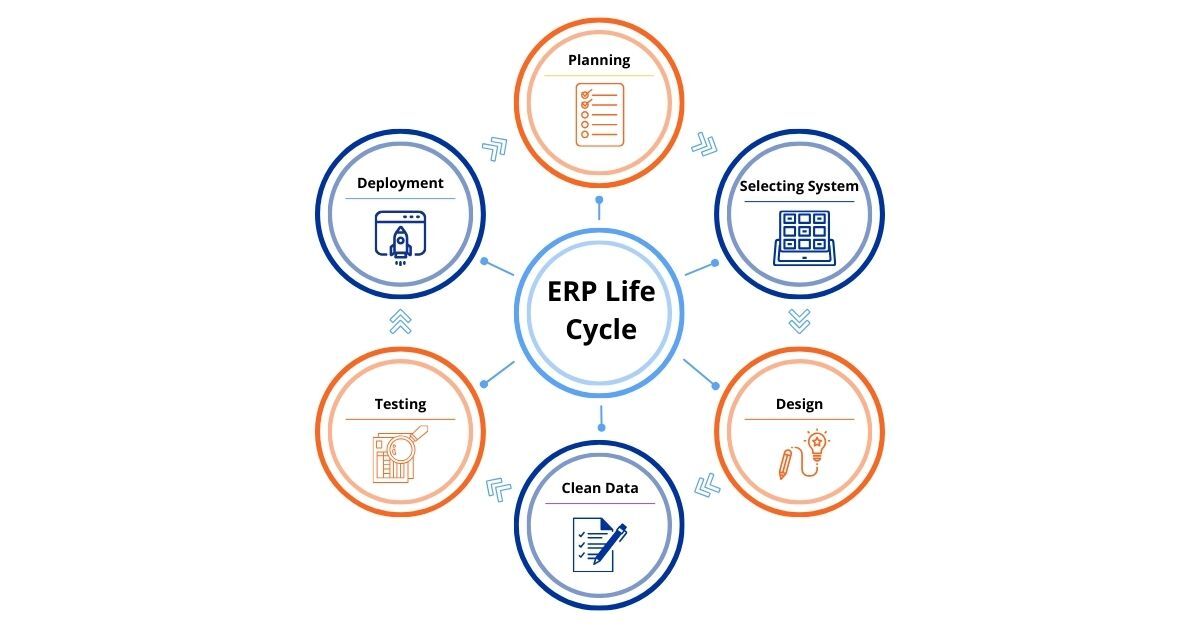
A PE ERP implementation runs across 5 sequential phases over 26 weeks, covering discovery, configuration, data migration, user acceptance testing, training, and go-live. Each phase feeds directly into the next. Compressing or skipping any phase produces data integrity failures, compliance gaps, or adoption breakdowns that extend the total implementation timeline past the original project plan.
Phase 1 — Discovery and Requirements Mapping (Weeks 1 to 6)
To begin implementation accurately, the project team maps requirements across 3 distinct layers simultaneously: GP entity, fund structure, and portfolio company.
GP entity requirements cover management fee income accounting, carried interest accrual structures, GP operating expense classification, and co-investment tracking. Fund structure requirements cover NAV calculation methodology, waterfall distribution logic, LP capital account structures, and ILPA reporting alignment. Portfolio company requirements cover standalone chart of accounts design, intercompany transaction coding rules, multi-currency configuration, and the rollup logic connecting each portfolio company to the GP consolidation layer.
The data audit runs across all existing systems at the same time, including QuickBooks instances, Excel models, fund administration platforms, and standalone reporting tools. The audit classifies data into 4 categories: clean data ready for migration, data requiring normalization, data with structural incompatibilities requiring transformation, and data gaps requiring manual reconstruction before go-live.
Defining the multi-entity chart of accounts is the single most consequential configuration decision in the entire implementation. A chart of accounts that does not support fund-level, GP-level, and portfolio company-level reporting simultaneously forces mid-implementation restructuring, adding 3 to 8 weeks to the project timeline.
Phase 2 — Configuration and Data Migration (Weeks 7 to 18)
To configure the ERP instance correctly, the implementation team applies PE-specific workflow logic across 6 functional areas before data migration begins: fund accounting module setup, multi-entity structure build, LP capital account configuration, intercompany elimination rule definition, currency conversion settings, and LP reporting template design. Each area requires validation against Phase 1 requirements before configuration advances.
Historical fund data migration runs across 3 sequential stages. Stage 1 migrates clean, normalized data from the fund administration platform and legacy systems into the configured ERP instance. Stage 2 runs reconciliation checks comparing migrated balances against source system records at fund level, GP entity level, and portfolio company level. Stage 3 resolves reconciliation exceptions, which average 8 to 15 per migration in PE implementations of standard complexity, before the data set advances to testing.
Integration builds with fund administration platforms, CRM systems, and BI tools run in parallel with data migration across weeks 10 to 18. Each integration follows 4 steps: API connection establishment, field mapping validation, test transaction execution, and error handling configuration. Integrations with fund administration platforms including Allvue and Investran carry the highest field mapping complexity because fund admin data structures use different account classification logic than ERP chart of accounts structures.
Phase 3 — User Acceptance Testing with Real Fund Data (Weeks 19 to 22)
To validate the configured ERP instance, UAT runs 3 test scenarios using actual fund data: LP report generation, capital call workflow execution, and multi-entity consolidation.
LP report generation testing produces capital account statements, quarterly financial reports, and distribution notices from the configured instance, then compares outputs line by line against the most recent fund administrator-produced reports. Discrepancies exceeding 0.5 percent of NAV at fund level trigger configuration review before UAT advances.
Capital call workflow testing executes a full capital call cycle, covering notice generation, LP commitment drawdown calculation, capital account update, and cash receipt recording, using actual LP commitment data from the current fund. The test confirms that capital call outputs match fund administrator records across all LP classes simultaneously.
Multi-entity financial rollup validation compares ERP-consolidated balance sheets and income statements against manually assembled consolidations from the existing system, reconciling intercompany eliminations, currency conversions, and minority interest calculations at each entity level. Rollup validation across 6 to 8 portfolio companies averages 60 to 90 reconciliation hours during this phase.
Phase 4 — Training and Change Management (Weeks 23 to 25)
To prepare GP and portfolio company teams for go-live, training runs across 2 parallel user tracks delivered over 3 weeks.
The GP finance team and IR team track covers 5 functional areas: fund accounting and NAV reconciliation workflows, LP capital account management and capital call processing, multi-entity consolidation and intercompany elimination procedures, LP reporting automation and investor portal administration, and management fee and carried interest accrual workflows. GP finance team training averages 40 to 60 hours per user across these 5 areas.
Portfolio company controller onboarding covers standalone financial reporting within the ERP, intercompany transaction coding against the GP-defined chart of accounts, and financial data submission procedures that feed the GP-level consolidation rollup. Controller training averages 20 to 30 hours per user.
Change management addresses 3 adoption barriers directly. Controllers transitioning from Excel require structured workflow documentation mapping each ERP-native process to the manual step it replaces. GP finance teams transitioning from standalone fund administration outputs require reconciliation training that builds confidence in ERP-produced NAV figures before fund administrator outputs are deprioritized. IR teams replacing manual LP report assembly with automated portal delivery require exception-handling training for LP data queries that fall outside automated report templates.
Phase 5 — Go-Live and Hypercare Support (Week 26 and Beyond)
To execute go-live without quarter-end disruption, the timing strategy positions the ERP launch at least 6 weeks before the next quarter-end close, giving the GP finance team one complete close cycle on the new system before LP reporting deadlines activate.
Acumatica PE implementations run 2 to 4 months from discovery to go-live, compared to the industry standard of 6 to 12 months for equivalent ERP scope. The compression comes from 3 sources: pre-built PE configurations that eliminate fund accounting build time, structured data migration methodology that reduces reconciliation cycles, and PE-experienced implementation partners carrying reusable chart of accounts templates, LP reporting frameworks, and intercompany elimination rule sets from prior PE deployments.
Hypercare covers the first 2 quarter-end close cycles post go-live across 4 support functions: real-time reconciliation assistance during close, LP report review before distribution, capital call workflow validation, and configuration adjustments identified during live close execution. Firms that go live without structured hypercare average 2 to 4 weeks of additional close cycle disruption in the first post-go-live quarter.
Common Implementation Pitfalls PE Firms Must Avoid
PE ERP implementations fail across 4 consistent patterns, each traceable to a specific decision made before or during the project.
Selecting a generalist Acumatica partner with no PE experience produces fund accounting configurations misaligned with waterfall distribution logic, LP capital account structures, and ILPA reporting requirements, adding 8 to 16 weeks of rebuild cycles to the original timeline.
Going live at quarter-end without a parallel close strategy puts the first live close cycle on an untested system while LP reporting deadlines run simultaneously, producing configuration exceptions, reconciliation failures, and LP report delays that average 3 to 5 weeks of recovery time.
Underestimating data migration complexity across portfolio companies produces incomplete historical data sets in the live instance, forcing GP finance teams to maintain legacy system access for historical lookups for 6 to 18 months post go-live, which directly defeats the consolidation objective the ERP was selected to achieve.
Operating without a dedicated PE implementation methodology runs the project on a generic ERP deployment framework that does not account for fund structure mapping, multi-entity chart of accounts sequencing, or LP capital account configuration order, surfacing configuration gaps during UAT rather than during the requirements phase, where resolution costs significantly less time and budget.