Skip to content


ERP Software for Agriculture   Full Operational and Financial Control in One Platform

Agribusinesses operating on disconnected systems face fragmented inventory, delayed reporting, and failed compliance audits. Acumatica ERP for agriculture integrates farm operations, financials, supply chain, and compliance into one cloud platform. ERP for Private Equity delivers Acumatica implementations with PE-grade financial architecture purpose-built for multi-entity agribusinesses ready to scale.

Acumatica ERP Software for Agriculture

Trusted by Agribusinesses Powered by Acumatica

acumatica-program_and_certification_badges-2026_-XRP- DEVELOPER
acumatica-program_and_certification_badges-2026_CONSTRUCTION AUTHORIZED-VAR (1)
acumatica-program_and_certification_badges-2026_GOLD CERTIFIED-SERVICES PROVIDER (1)
acumatica-program_and_certification_badges-2026_DISTRIBUTION- AUTHORIZED-VAR

Is Your Agribusiness Still Running on Disconnected Systems?

Your farm operations run in one system. Your agribusiness financials sit in another. Your supply chain data lives in a spreadsheet nobody trusts.

Each season-end close takes weeks of manual reconciliation. Field activity records never match general ledger entries. Perishable inventory counts are updated after stock losses occur. Food safety compliance audits expose traceability gaps that fragmented farm management software created months earlier.

Multi-entity agribusinesses lose real-time visibility across crop operations, procurement cycles, outgrower contracts, and investor reporting simultaneously. Disconnected ERP systems do not just slow decisions — they erode operating margins, create FSMA and USDA compliance risk, and block agribusiness scalability.

ERP software for agriculture eliminates these operational gaps — integrating farm operations, financial consolidation, supply chain visibility, and regulatory compliance into one cloud platform, in real time.

Is Your Agribusiness Still Running on Disconnected Systems?


Professional Services Firms Operate Differently Your ERP Should Too


Generic ERP systems are engineered for product-based businesses. Professional services firms managing billable time, project margins, resource utilization, and multi-entity financials operate on fundamentally different requirements. The result: revenue leakage, reporting delays, and zero visibility into project-level profitability.


No Visibility Into Project-Level Profitability

Project-level profitability tracks revenue, cost, and margin per engagement. Generic ERP reports at company level only. Firms running multiple simultaneous engagements lose an average of 18% gross margin annually — invisible losses that compound across every project cycle.

Billing Delays From Disconnected Timesheets

Disconnected timesheet systems break the direct link between time entry and client invoicing. Professional services firms experience invoice delays of 8–14 days per billing cycle directly aging accounts receivable and reducing monthly cash flow.

Manual Revenue Recognition Draining Your Finance Team

Revenue recognition under ASC 606 and IFRS 15 requires percentage-of-completion tracking, milestone adjustments, and deferred revenue entries per engagement. Without automation, finance teams spend 12–15 hours weekly on manual entries — increasing audit risk and misstating project profitability.

No Real-Time View Across Projects, Resources and Cash Flow

Real-time visibility across project accounting, resource utilization, and cash flow requires a single integrated system. Generic ERP delivers reports 5–7 days behind live operational data making accurate decisions across PE-backed portfolios impossible.

Month-End Reporting That Takes Days — Not Minutes

Month-end close in professional services involves WIP reconciliation, intercompany eliminations, and multi-entity consolidation. Firms on generic ERP average 8–12 days to close monthly books. Disconnected systems are the primary cause.

Multi-Entity Structures That Generic ERP Simply Can't Handle

Multi-entity consolidation requires intercompany accounting, multi-currency translation, and portfolio-level reporting across all operating entities. Generic ERP requires $45,000–$120,000 in custom development to support basic multi-entity structures a cost PE-backed firms absorb repeatedly without resolution.

How It Works — ERP for Professional Services
Implementation Process

From Day One to Full Visibility —
Here's How It Works

Professional services ERP implementation follows three structured phases — each delivering measurable operational improvement before the next begins.

 
Step 01

Connect Projects, People and Finances in One Place

Acumatica ERP centralizes project accounting, resource allocation, timesheet management, and general ledger into one system. Every billable hour and project cost flows into a single data source — eliminating manual reconciliation.

1
🔗 Unified Data Source

Project Accounting · Resource Planning · General Ledger · Timesheet Management

Step 02

Get Real-Time Visibility Across Billing, Utilization and Profitability

Real-time dashboards surface project-level profitability, resource utilization rates, and cash flow — updated live. PE-backed firms access consolidated financial data across every portfolio entity from one interface.

2
📊 Live Visibility

Utilization Rates · Billing Pipeline · Project Profitability · Cash Flow Position

Step 03

Close Faster, Report Smarter and Scale Without Chaos

Automated workflows handle WIP reconciliation, ASC 606 revenue recognition, and multi-entity consolidation — reducing month-end close from 8–12 days to 2–3 days. Finance teams scale reporting without adding headcount.

3
Faster Close

WIP Reconciliation · ASC 606 · Intercompany Eliminations · Multi-Entity Consolidation


Everything Your Professional Services Firm Needs — In One Platform

 Acumatica ERP consolidates project accounting, resource planning, and revenue recognition into a single cloud platform — built for PE-backed professional services firms managing complex, multi-entity operations. 

Project Accounting & Billing

Manage project billing, milestone invoicing, and retainer contracts from one unified ledger. Acumatica's project billing ERP eliminates revenue leakage by connecting every billable event — time entries, expenses, and deliverables — directly to client invoices and the general ledger.

Time & Expense Management

Capture billable hours and reimbursable expenses with precision using integrated timesheet software. Mobile-friendly time entry, automated approval workflows, and real-time billable hours tracking ensure every revenue-generating hour reaches the invoice.

Resource Planning & Utilization

Maximize billable capacity with real-time utilization tracking and forward-looking capacity planning. Assign the right resource to the right project, monitor utilization rates by team or individual, and prevent revenue loss from under-staffed or over-committed engagements.

Revenue Recognition & Compliance

Automate ASC 606-compliant revenue recognition across fixed-fee, time-and-materials, and milestone-based contracts. Manage deferred revenue schedules, WIP adjustments, and financial compliance reporting without manual journal entries or spreadsheet workarounds.

Financial Reporting & Dashboards

Access real-time P&L by project, client, or business unit. Configurable KPI dashboards surface cash flow position, billing pipeline, and margin performance giving finance leaders the visibility needed to act before month-end close.

Multi-Entity & Consolidated Financials

Run intercompany accounting, shared services allocation, and consolidated financial reporting across every portfolio entity from one platform. Multi-entity ERP eliminates manual consolidation and accelerates reporting for PE sponsors and CFOs managing multiple operating companies.

 What ERP for Private Equity Delivers That  Generic Resellers Do Not  


ERP for Private Equity is an Acumatica Certified Partner specializing in agriculture ERP implementations for PE-owned and multi-entity agribusinesses. Every implementation is architected around three non-negotiable outcomes: operational visibility, financial consolidation, and investor-grade reporting.

Generic Acumatica resellers implement the platform. ERP for private Equity implements the platform with PE-grade financial architecture — multi-entity chart of accounts, intercompany transaction management, and consolidated reporting across all farm entities on a single license.

Agribusinesses managing horticulture, livestock, food processing, or outgrower contracts receive implementations structured around their specific operational model not a generic agriculture template. Post go-live support covers system optimization, seasonal demand configuration, and compliance reporting updates as FSMA and USDA regulatory requirements evolve.

why Choose erp for pivate equity ERP for Professional Services

What Customer Say About Our Services?

 We were losing billable hours to manual timesheet reconciliation and disconnected project billing. ERP for Private Equity gave us real-time utilization tracking and milestone billing in one platform — our realization rate improved by 18% within the first quarter. 

 Managing six portfolio companies on separate systems made consolidated reporting a nightmare. ERP for Private Equity's intercompany accounting and live KPI dashboards gave our operating partners and LP reporting team a single source of truth finally. 

 Before ERP for Private Equity, our month-end close took nearly two weeks across four entities. Now we consolidate financials in under three days. The multi-entity reporting and ASC 606 automation alone justified the entire implementation. 

Ready to Run Your Agribusiness on a Smarter ERP for Agriculture?

Disconnected spreadsheets, missed compliance deadlines, and zero real-time visibility are costing your farm more than time. You have seen what the right agriculture ERP can do — now it is time to put it to work for your operation.

Book a Free Demo | Download the Agriculture ERP Buyer's Guide | Talk to a Specialist

Frequently Asked Questions

How can an ERP benefit my agriculture business?

An ERP benefits your agriculture business by unifying farm operations, financials, supply chain, and compliance into one platform. It eliminates data silos, reduces manual errors, improves crop-to-sale traceability, and delivers real-time insight that helps you cut costs and increase yield profitability.

An agriculture ERP connects every part of your business — from field activity logs and inventory management to payroll and regulatory reporting. Instead of managing spreadsheets, paper records, and disconnected software, your entire operation runs from a single system.

Key benefits include:

  • Operational visibility — Track land use, crop cycles, labour, and machinery costs from one dashboard.
  • Financial accuracy — Automate accounts payable/receivable, budget forecasting, and cost-per-acre reporting.
  • Supply chain control — Manage procurement, inventory, and distribution of seeds, fertilisers, and harvested produce.
  • Regulatory compliance — Maintain audit-ready records for DEFRA, GlobalG.A.P., and food safety standards.
  • Labour management — Schedule seasonal workers, track hours, and automate payroll for variable headcounts.
  • Scalability — Support single-farm, multi-site, or full agribusiness operations without changing platforms.

Agriculture businesses that implement an ERP typically report significant reductions in administrative overhead and faster decision-making due to unified, real-time data across all departments.

What features should I look for in an ERP system designed for the agriculture industry?

An agriculture ERP should include crop and field management, livestock tracking, inventory and warehouse control, financial management, traceability, compliance reporting, mobile access, and integration with IoT or precision farming tools. These features ensure end-to-end visibility across every farming operation.

When evaluating an agriculture ERP, go beyond generic business software features. Agriculture has unique operational demands — seasonal labour, lot-level traceability, chemical application records, and multi-site crop tracking — that require purpose-built functionality.

Essential features to look for:

  • Crop and field management — Planting schedules, field mapping, yield tracking, and soil data management per plot.
  • Inventory and warehousing — Seed, chemical, and produce stock control with expiry dates and batch tracking.
  • Financial management — Cost-per-crop reporting, multi-entity accounting, and budget vs. actuals analysis.
  • Traceability and compliance — Lot-level traceability from field to consumer with regulatory audit trails.
  • Labour and equipment — Seasonal workforce scheduling, machinery maintenance logs, and utilisation tracking.
  • IoT and sensor integration — Connect weather stations, soil sensors, and GPS-guided machinery for automated data capture.
  • Mobile and offline access — Field operatives must be able to work without internet connectivity and sync data automatically.
  • Reporting and analytics — Configurable dashboards and KPI scorecards for real-time operational and financial insight.

Avoid ERP systems that have been generically adapted for agriculture. Look for platforms with pre-configured agriculture modules, proven customer references in the sector, and a clear roadmap for precision farming and AI integration.

How do I implement an ERP system in my agricultural business?

Implementing an ERP in your agricultural business involves six key steps: define your requirements, select a specialist vendor, plan your data migration, configure the system for your crop and livestock workflows, train your team, and go live in phases. A structured rollout minimises disruption to seasonal operations.

ERP implementation in agriculture requires careful timing around planting and harvest seasons. A poorly timed go-live during peak operations can create serious disruption. Working with an experienced agriculture ERP implementation partner significantly reduces risk and compresses timelines.

Step-by-step implementation process:

  1. Requirements gathering — Document current workflows, pain points, number of users, and compliance obligations before evaluating any system.
  2. Vendor selection — Shortlist ERP providers with proven agriculture experience. Evaluate demos, reference customers, and total cost of ownership.
  3. Data migration planning — Audit existing data (fields, inventory, financials) and plan cleansing, mapping, and migration timelines.
  4. System configuration — Configure modules for your specific crops, livestock, warehouse locations, and compliance standards.
  5. Training — Run role-based training for farm managers, finance teams, and field operatives — including mobile and offline use.
  6. Phased go-live — Launch one module or location at a time. Avoid go-lives during peak harvest or planting seasons.
  7. Post-go-live support — Ensure hypercare support for the first 30–60 days and schedule quarterly system reviews.

Typical agriculture ERP implementations range from 60 to 180 days depending on business complexity, number of sites, and data readiness.

How does Microsoft Dynamics leverage AI in agriculture to provide predictive analytics and decision support?

Microsoft Dynamics 365 leverages AI in agriculture through Copilot-powered analytics, Azure Machine Learning integrations, and predictive models that forecast demand, yield, and equipment failure. This enables farm managers and agribusiness leaders to make proactive, data-driven decisions rather than reactive ones.

Microsoft Dynamics 365 connects with Azure IoT Hub, Power BI, and Azure Machine Learning to turn raw farm data — weather, soil sensors, equipment telemetry, financial records — into actionable intelligence. The Copilot feature allows users to ask questions in plain English and receive instant data-backed answers without needing to run manual reports.

AI capabilities in Microsoft Dynamics for agriculture:

  • Yield forecasting — AI models analyse historical yield data, weather patterns, and soil health to project seasonal output with greater accuracy.
  • Demand planning — Predictive demand analytics help agribusinesses align production, storage, and distribution with expected market demand.
  • Predictive maintenance — Machine learning monitors equipment sensor data to flag maintenance needs before breakdowns occur, reducing costly downtime.
  • Financial forecasting — Copilot in Dynamics 365 Finance analyses cost trends and generates scenario-based budget forecasts automatically.
  • Supply chain risk signals — AI-driven alerts identify supplier delays, weather-related disruptions, or inventory shortfalls in advance.
  • Natural language queries — Users can ask Copilot questions like "What is my projected wheat yield for Q3?" and receive instant, data-backed answers.

Microsoft Dynamics 365 integrates with Azure IoT Hub and Power BI, allowing agribusinesses to build custom AI dashboards that connect precision farming data directly with operational and financial decision-making.

What makes our ERP the best ERP software for agriculture?

ur agriculture ERP stands apart through deep industry-specific configuration, end-to-end traceability from field to consumer, seamless mobile and offline functionality for remote field use, and a proven implementation track record. It is purpose-built for the unique workflows and compliance demands of modern farming operations.

Generic ERP platforms were built for manufacturing or retail and retrofitted for agriculture. That approach forces farms to work around the software rather than with it. Our solution ships with pre-configured agriculture modules — crop management, compliance workflows, seasonal labour, and traceability — so go-live is faster and adoption is higher.

What differentiates our ERP from generic solutions:

  • Agriculture-first design — Built around crop cycles, seasonal labour, and agri-compliance from the ground up.
  • Field-to-fork traceability — Complete lot and batch tracking from planting through processing, packing, and delivery.
  • Proven implementation methodology — Delivered by specialist consultants with hands-on agriculture sector experience.
  • Unified platform — Finance, operations, supply chain, HR, and compliance in one integrated system with no patchwork of third-party tools.
  • Mobile and offline capability — Field operatives can record activities without connectivity, with automatic sync on reconnection.
  • Scalable architecture — Supports single farms through to large multi-site agribusiness operations without platform changes.

Unlike horizontal ERP platforms that require extensive customisation to fit farm workflows, our solution is ready to deploy for agriculture from day one.

Can agricultural ERP solutions support mobile access and offline use in the field?

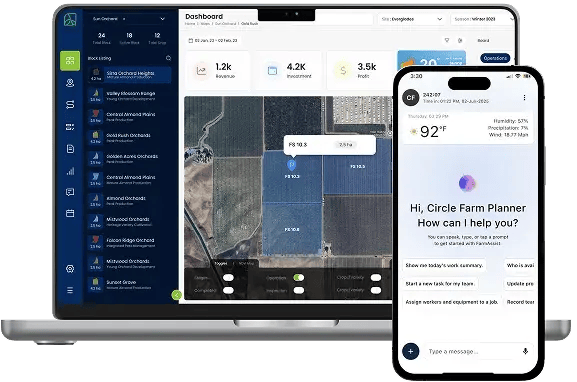
Yes. Modern agricultural ERP solutions support mobile access through dedicated apps for iOS and Android, and many include offline functionality that allows field workers to record data without internet connectivity. Records automatically sync when a connection is restored, ensuring no data is lost in remote areas.

Mobile ERP capability is not a nice-to-have in agriculture — it is essential. Field operatives work in areas with limited or no connectivity. Without offline functionality, critical data including spray records, harvest logs, and equipment checks either gets missed or entered manually later, creating errors and compliance gaps.

Mobile and offline capabilities in a modern agriculture ERP:

  • Native mobile apps — Field operatives can log crop activities, equipment usage, chemical applications, and labour hours from a smartphone or tablet.
  • Offline data capture — Activities recorded offline are stored locally and synced automatically once connectivity resumes.
  • Role-based mobile interface — Farm managers, supervisors, and field workers each see a tailored view showing only the tasks and data relevant to their role.
  • GPS and location tagging — Mobile ERP apps support GPS stamping on field records, tying activities to specific plots or coordinates.
  • Photo and document capture — Field staff can attach photos of crop conditions or pest damage directly to activity records in real time.

Choosing an agriculture ERP with robust offline support eliminates data entry delays, improves record accuracy, and ensures compliance documentation is complete even in the most remote field locations.

Will an agriculture ERP help with traceability, compliance, and quality control?

Yes. An agriculture ERP provides end-to-end traceability from seed to sale, automates compliance documentation for standards like GlobalG.A.P., HACCP, and DEFRA requirements, and enforces quality control checkpoints throughout production. This reduces audit preparation time and minimises the risk of non-compliance penalties.

Traceability and compliance are among the most operationally complex challenges in modern agriculture. Regulatory bodies, retail customers, and export authorities demand accurate, complete records across every stage of production. An agriculture ERP makes this manageable by capturing and storing compliant records automatically as part of normal daily workflows.

Traceability, compliance, and quality control features:

  • Lot and batch traceability — Track every input (seeds, chemicals, fertilisers) and output through each production stage with full forward and backward trace capability.
  • Recall readiness — In the event of a food safety issue, instantly identify affected batches and generate recall reports in minutes.
  • Compliance documentation — Automatically generate audit-ready records for DEFRA, the Food Standards Agency, and export certification authorities.
  • Quality control workflows — Configure inspection checkpoints at harvest, packing, and dispatch stages with pass/fail criteria and exception alerts.
  • Chemical and pesticide logs — Maintain certified spray records with applicator details, product registration numbers, and withdrawal periods.
  • Certification management — Track organic, fair trade, or GlobalG.A.P. certification validity and renewal deadlines within the system.

An agriculture ERP transforms compliance from a reactive, time-consuming process into an automated, always-audit-ready function embedded in day-to-day operations.

How scalable is an agriculture ERP for expanding farms or multi-location operations?

A modern agriculture ERP is highly scalable, supporting growth from a single farm to multi-site, multi-entity, or international agribusiness operations without changing platforms. It accommodates additional users, locations, crop types, and entities through configuration rather than costly redevelopment.

Scalability is one of the most strategically important factors when selecting an agriculture ERP. Many farms start with basic requirements but grow rapidly — adding new sites, acquiring neighbouring land, diversifying into processing or direct-to-consumer sales, or expanding internationally. Choosing a platform that scales through configuration protects your investment as the business evolves.

How scalability works in practice:

  • Multi-site management — Manage multiple farms, processing facilities, or warehouses under one system with site-specific reporting and consolidated group views.
  • Multi-entity accounting — Run separate legal entities or joint ventures within the same ERP with intercompany transactions and consolidated financials.
  • Modular expansion — Start with core finance and crop management, then activate additional modules — HR, logistics, ecommerce — as the business grows.
  • User and role management — Add unlimited users with granular role-based permissions as your team scales seasonally or permanently.
  • Cloud infrastructure — Cloud-hosted agriculture ERPs scale compute and storage resources automatically without hardware upgrades or IT capital expenditure.
  • International operations — Multi-currency, multi-language, and multi-tax support enables expansion into new geographic markets without platform changes.

Agribusinesses that outgrow their ERP face expensive re-implementation projects. Investing in a scalable platform from the outset avoids this disruption entirely.

What core modules should I look for when choosing an ERP for farm management?

When choosing an ERP for farm management, the core modules to prioritise are crop and field management, financial management, inventory and warehouse control, procurement, labour and HR, traceability and compliance, equipment maintenance, and reporting and analytics. These modules collectively cover the full farm operational cycle.

Not every farm needs every module from day one. A phased approach — starting with financial management and crop tracking — allows you to demonstrate ROI quickly before expanding into advanced capabilities like predictive analytics and IoT integration.

Core farm ERP modules explained:

  • Crop and field management — Field mapping, planting plans, activity logs, input usage, and yield recording per crop and plot.
  • Financial management — General ledger, accounts payable/receivable, cost accounting, and farm-specific profit and loss reporting.
  • Inventory and warehouse — Stock management for seeds, agrochemicals, and harvested produce with batch and location tracking.
  • Procurement — Purchase order management, supplier contracts, goods receipting, and spend analysis.
  • Labour and HR — Seasonal workforce scheduling, timesheet capture, payroll integration, and contractor management.
  • Equipment maintenance — Planned maintenance schedules, fault logging, parts inventory, and cost-per-asset tracking.
  • Traceability and compliance — Lot tracking, spray records, audit trails, and certification management for regulatory reporting.
  • Reporting and analytics — Configurable dashboards, KPI scorecards, and drill-down reports across all operational areas.

When evaluating vendors, ask which of these modules are included natively and which require third-party integrations. A fully native module set reduces integration costs, data fragmentation, and long-term maintenance overhead significantly.


Read Our Latest Blog