
 ERP Fundamentals
ERP (Enterprise Resource Planning)
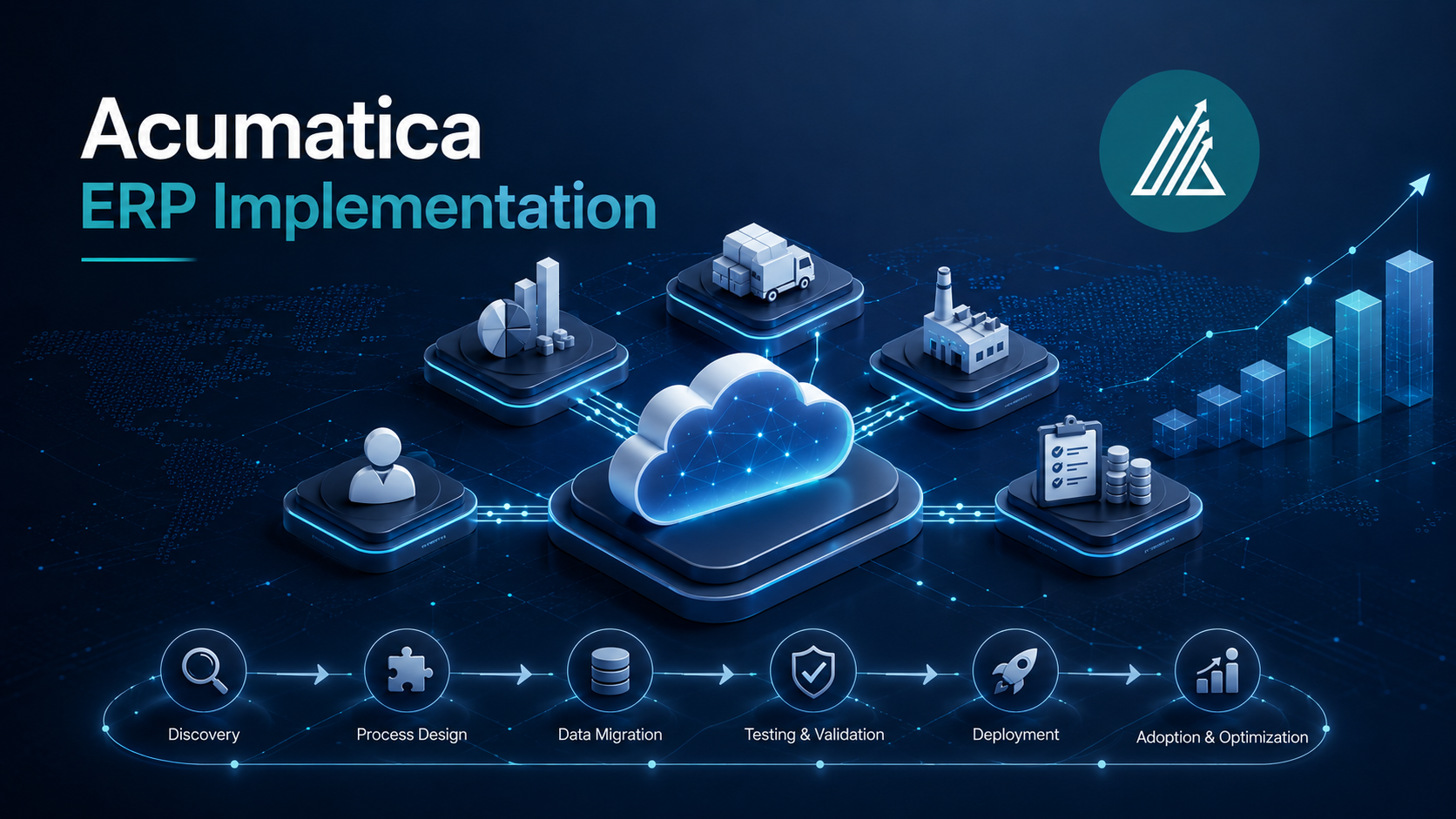
Enterprise Resource Planning (ERP) is business management software that connects an organization's core functions including finance, accounting, operations, inventory, manufacturing, purchasing, sales, customer service, and reporting into one integrated system. Rather than relying on disconnected spreadsheets and multiple software applications, an ERP platform provides a single source of truth for business data and decision-making.
Why It Matters
As organizations grow, disconnected systems create inefficiencies, duplicate data, manual processes, and limited visibility into business performance.
A modern ERP solution helps organizations:
- Improve operational efficiency
- Automate repetitive tasks
- Reduce manual data entry
- Increase financial visibility
- Improve reporting accuracy
- Support business growth
- Make faster, data-driven decisions
For many organizations, ERP becomes the operational backbone of the business.
Private Equity Perspective
For private equity firms and portfolio companies, ERP plays a critical role in value creation.
An integrated ERP platform enables:
- Faster financial reporting
- Standardized business processes
- Easier post-acquisition integration
- Multi-entity consolidation
- Improved KPI visibility
- Greater scalability for future acquisitions
A well-implemented ERP system helps management teams make informed decisions while providing investors with reliable operational and financial insight.
Common Challenges
- Multiple disconnected software systems
- Spreadsheet-driven reporting
- Manual month-end close processes
- Inconsistent data across departments
- Limited executive visibility
- Difficulty integrating acquired companies
Best Practices
- Define clear business goals before selecting an ERP
- Focus on business process improvement—not simply replacing software
- Choose an implementation partner with industry expertise
- Invest in user training and change management
- Continue optimizing the ERP after go-live
AccountAbility Insight
One of the biggest misconceptions we hear is "We need new ERP software." In reality, most organizations don't have software problems, they have a process problem. The most successful ERP implementations begin by evaluating how the business operates today and identifying opportunities to improve efficiency before configuring technology. ERP should support better business processes, not simply replacing an old system.
How AccountAbility Can Help
AccountAbility helps private equity-backed and growth-focused organizations evaluate, implement, optimize, and support ERP solutions that improve financial visibility, operational efficiency, and long-term business value.
Related Terms


Ready to Talk?
Schedule a complimentary ERP Strategy Session with one of our experienced consultants.
Book a Strategy Session →